
News
Stay updated with the latest from Volunteering New Zealand



Community
Inclusion
Volunteers
Wellbeing
The Creative Spark
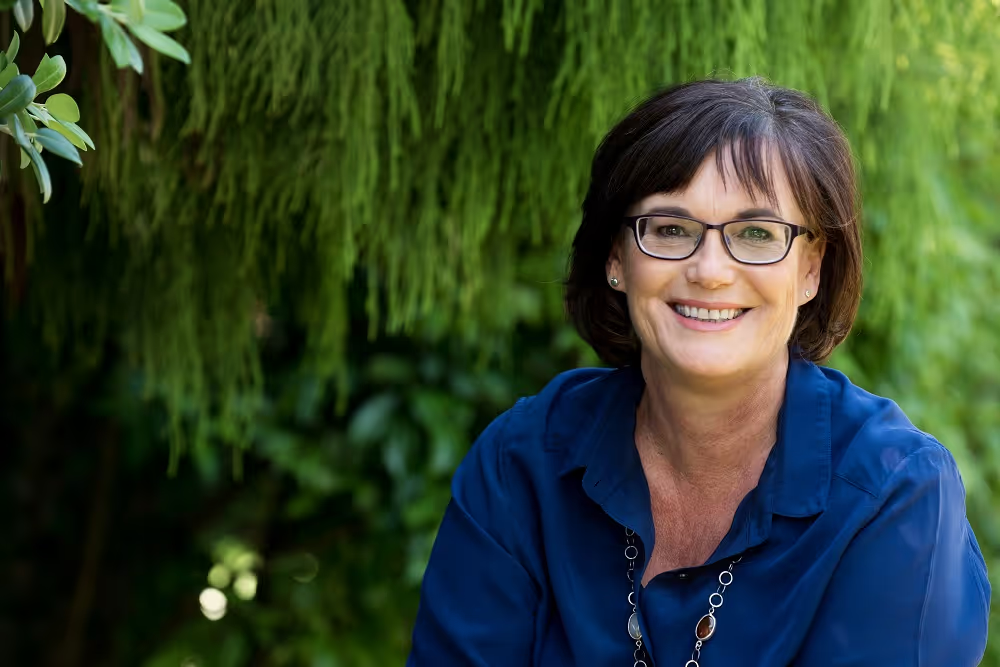
I started volunteering at Hawke’s Bay prison as my teaching career drew to a close.
I knew I didn’t want to work full-time anymore, but I also knew I’d miss teaching, and specifically teaching writing.I hadn’t realised how much I’d enjoy working with the men at the prison – and in fact, the more I’ve done, the more I’ve loved it.Mainly, I work with groups of 5-10 men, writing creatively.
My goal with each group is to get their voices on the page.
The work we do evolves as I get to know the group, but some aspects have become constant.The first time I met a group, I was nervous and unsure about what would work, so I fumbled around and tried a few different activities.
Eventually, I got them to just write one sentence, beginning, “I am…”.
Once they’d done that, I asked them to put the sentences together, deciding on the order as they went, and then give their poem a title.
The result — both the poem and its effect on the men – amazed me.
There was a shift in the room, from tension about writing to awareness of its possibilities, and a new sense of a shared endeavour.
Here’s that poem:
An Ordinary Guy
I am a warrior from a long line of chiefs.
I am the type to listen before you speak.
I am the person in Cell 55.
I am the person in the front of the class thinking how did I come to stand here?
I am the person who is lost in the moment.
I am a man leading my soldiers to war.
I am an artist.
My body is my canvas.
I am an alien in a foreign country.
I am the fulla with the scar on my face.
I am an ordinary type of guy.
I always begin classes this way now.
It’s less stressful for participants at the start to write only one sentence, and powerful when their experiences weave together into fresh narratives.
After that, I have a variety of starters to use, depending on the group and the moment.
After the Christchurch terrorist attack, for example, I asked the men to write a response to ‘My Aotearoa’.
By the final class, we focus on selecting and editing drafts, with the completed pieces forming a small anthology which each member of the group gets a copy of.I don’t want to give the impression I’m in any way selfless in running these classes.
I get at least as much from it as the men do.
That moment when a story or poem that didn’t exist is now in the world – there’s no better feeling.
And, as every teacher knows, it’s such a blast when someone ‘gets it’: when they realise they’ve put something on a page that captures their thoughts, or their heart, or their story.JoHawkesbay Regional Prison
Interactive Volunteer Stories Map
This story was shared as part of our interactive map of volunteer stories from across Aotearoa, which we launched during #NVW2019.
This map is filled with stories from volunteers throughout Aotearoa, New Zealand.
This map celebrates the contribution of volunteers in their communities throughout Aotearoa.
It aims to inspire people to engage in volunteering, Mahi Aroha and social action and to realise the benefits of weaving their communities together through their actions.
Community
Leadership
Wellbeing
Youth
Seeing the good in people
Clare Daish recently joined Youthline as the newsletter editor for the comms team.
Currently working for the Parliamentary Services, she is also studying nursing at Whitireia Polytechnic.So what inspired her to add a volunteering role to her already busy life?“I think I was inspired to join Youthline because I’ve seen first hand how much young people can struggle in today's society.
I’ve had a lot of peers describe feeling like they can’t talk to anyone in their life about their feelings for various reasons.
I think that this is where Youthline comes in handy.
I basically just wanted to help out in whatever small way possible to hopefully spread some awareness on youth wellbeing and how Youthline can help those in need.”She credits her fellow volunteers for keeping her on top of things when struggling to juggle all her commitments.“I like the attitudes of all my fellow Youthline volunteers.
The atmosphere they create is so welcoming and positive.
It makes me feel very optimistic that this amazing group of people are taking time out of their busy lives to help out our youth and shape our next generation.”

She has already learned a lot from her time at Youthline, and it has taught her a great deal about volunteering, and people in general.“It is all very heart-warming seeing the good in people.
There is a great range of things that Youthline does to benefit the young people of New Zealand.
I think that even simply raising awareness of mental wellbeing, and being there for other people, makes large change in our societies attitudes towards these more taboo topics.“I believe that fostering the healthy attitudes and positive values that Youthline promotes, this is helping shape our young people into their best selves.
This will ultimately benefit New Zealand society in the future.”
Claire DaishYouthline Wellington
Interactive Volunteer Stories Map
This story was shared as part of our interactive map of volunteer stories from across Aotearoa, which we launched during #NVW2019.
This map is filled with stories from volunteers throughout Aotearoa, New Zealand.
This map celebrates the contribution of volunteers in their communities throughout Aotearoa.
It aims to inspire people to engage in volunteering, Mahi Aroha and social action and to realise the benefits of weaving their communities together through their actions.

Community
Settlement
Volunteers
Wellbeing
Volunteering in Northland: ‘I just love the feeling of having done something good’

When Shashi Kariyawasam came to New Zealand from Sri Lanka in 2018, she'd never done any volunteering.
That soon changed.The 29-year-old volunteered at Special Olympics and got involved with Multicultural Whangarei for a resettlement programme at the Whangarei Migrant Centre.“I worked as a coordinator at the Special Olympics, so I would go to trainings and practices and help cheer up the athletes and help them,” Shashi says. “I also worked at the Migrant Centre on a new project, helping to empower new migrants gain employment”.Having left Sri Lanka to get a better education, Shashi fell into volunteering through her course at NorthTec.“On the first day at NorthTec they dragged us to the Volunteering Northland Centre and told us we could volunteer as a firefighter, we could cook, garden”.She says she loves volunteering for the sense of satisfaction she gets out of helping people.“At the end of the day, I just love the feeling of having done something good and accomplishing something.”But volunteering has served another purpose for Shashi – making friends and meeting people. “Earlier I didn't know anyone here, and now they all know me so that's really good.”Continuing her volunteering efforts, Shashi has also helped Volunteering Northland at community events, and both her and her husband Manoj have enjoyed volunteer face-painting at the Pasifika Fusion Festival in Whangarei.
Other volunteer roles included being an Area Coordinator for Pink Ribbon Street Appeal and supporting the Cancer Society – Relay for Life.
Shashi is now continuing the good work of Rotary International as one of South Rotary Whangarei's newest members.Shashi's efforts in the Whangarei community are really making a difference.Original story by: Staff reporter of the Northern Advocate.Story sent to us by: Volunteering Northland
Interactive Volunteer Stories Map Launched
For NVW, Volunteering New Zealand has launched an interactive map of volunteer stories from across Aotearoa.
This map is filled with stories from volunteers throughout Aotearoa, New Zealand.
This map celebrates the contribution of volunteers in their communities throughout Aotearoa.
It aims to inspire people to engage in volunteering, Mahi Aroha and social action and to realise the benefits of weaving their communities together through their actions.
Conservation
Leadership
Research
Putting in the mahi to protect the next generation of kiwi
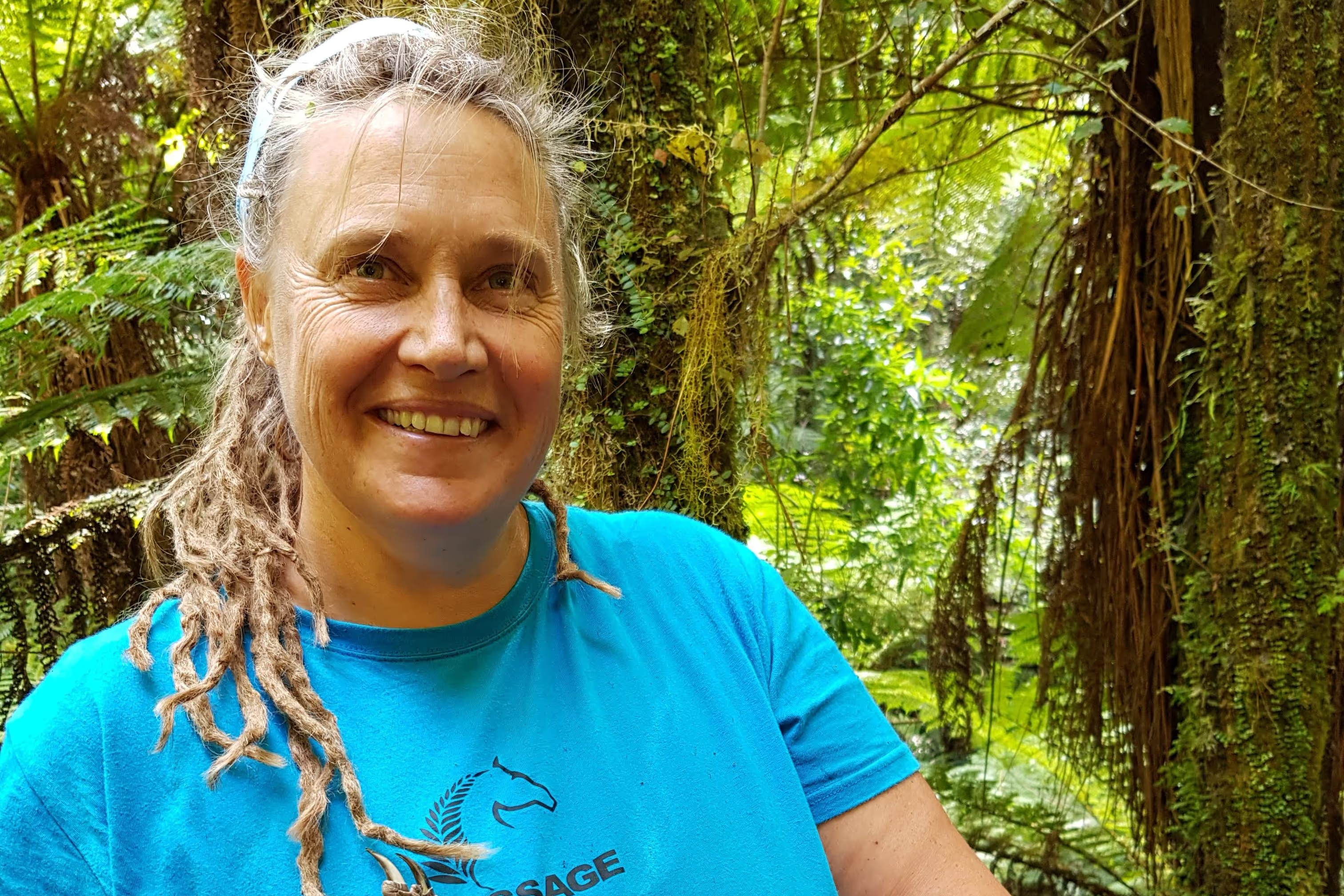
When Celine Filbee joined the Taranaki Kiwi Trust as manager, she decided to experience firsthand the work its volunteers do — by joining an egg-lifting mission.The Taranaki Kiwi Trust helps protect the wild kiwi that live in the steep bush around northern Taranaki.
The trust monitors the birds through transmitters attached to their legs, and volunteers embark on carefully-timed missions to remove any eggs the kiwi lay.
The eggs are transported to the National Kiwi Hatchery in Rotorua for incubation, and when the chicks are big enough, they are taken back to Taranaki to be released in a protected area.
This increases the chances of a wild chick surviving by up to 50 per cent.Celine’s first egg-lifting mission was a memorable experience.
It began with a 6.30am meet up, followed by a 90 minute drive into the remote Waitaanga conservation area.“They start early, that’s for sure!” she says. “Teams set off in different directions, armed with a water bottle each, equipment for transmitter changes, telemetry gear and a small chilly bin, both of which are cumbersome in the bush.”Celine and her team trekked through the bush until they reached the stomping ground of Winter, one of the wild birds monitored by the trust.
The telemetry gear used to monitor Winter provided valuable information about the bird’s recent activity, but for Celine, finding the kiwi wasn’t as simple as she had anticipated.
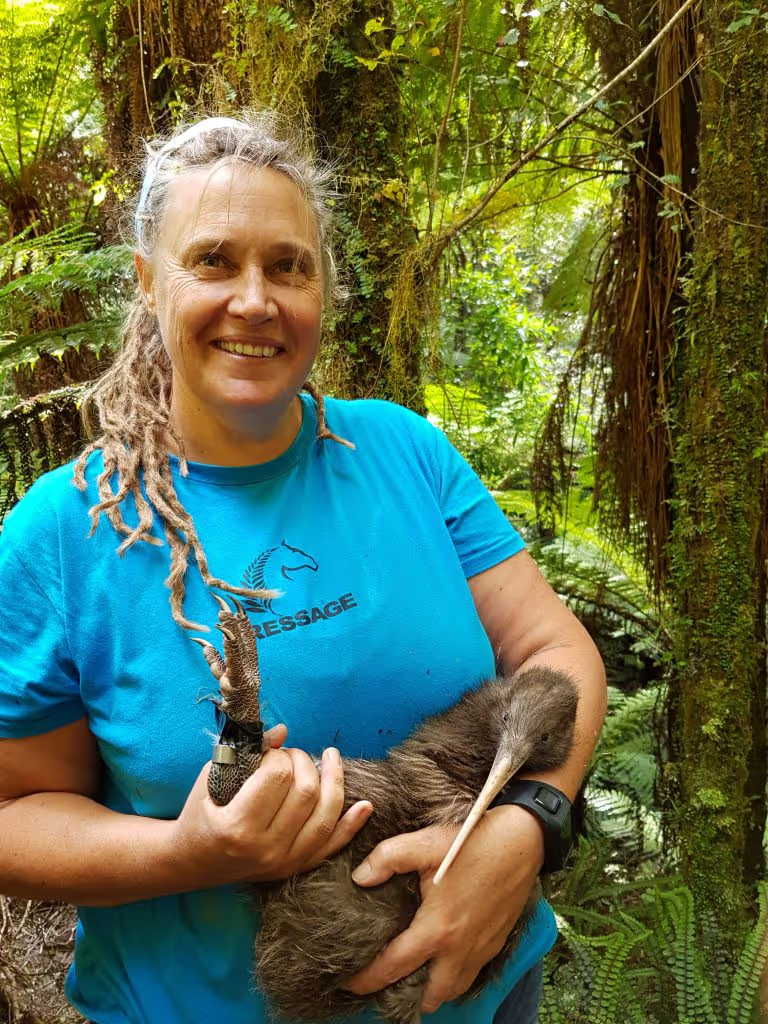
“It took us over an hour to track down Winter’s burrow,” Celine remembers. “It would seem this is not unusual, an exercise in patience for the most impatient person in the world, peppered with clambering up and down banks, crossing a small tributary of the river on very slippery papa several times, all while trying to be quiet!”Eventually, the team uncovered the burrow, and after “a little bush whacking”, team member Sue emerged carrying Winter.
Celine was then tasked with holding the wild bird while Sue performed transmitter maintenance, measured Winter’s bill and did a health check.“Luckily Winter was calm while Sue replaced his transmitter for one with a new battery,” Celine says. “She then went back into the burrow to retrieve the two huge eggs nestled there.
They went into the chilly bin in a new burrow of work socks which had been warmed previously using a hot water bottle.
Winter was returned safely to his nest and we set off sliding down banks, clambering over trees and rock hopping back up the river, but this time I had been entrusted with the cargo, two kiwi eggs!”Celine made her way with the precious cargo back to the vehicles, where the volunteers met to compare notes — and eggs.
In total, the teams found four eggs on the trip, which would later be transported to the hatchery by another volunteer.The day was a long one, but the experience showed Celine just how much effort volunteers put in to help protect one of New Zealand’s most beloved birds.Celine FilbeeTaranaki Kiwi Trust
This story was shared during #NVW2019 and a campaign aimed to inspire people to engage in volunteering, Mahi Aroha and social action and to realise the benefits of weaving their communities together through their actions.
Health
Wellbeing
Dealing a good hand at Servants Health Centre
Changing the odds for people who have been dealt a bad hand in life — that’s why Rita volunteers her time at Servants Health Centre.Dunedin’s Servants Health Centre provides free healthcare to people who would otherwise struggle to afford medical treatment.
It was founded in 2010 by two doctors and a midwife, who recognised the need for the service in the city and were inspired by their Christian faith to help others.Rita is one of the volunteers at the centre, and she says she gets a real sense of fulfilment from her work.“I came to Servants because of a desire to contribute,” she explains. “So many people have been dealt a ‘bad hand’: sexual abuse, physical abuse, abandonment, non-acceptance.
We’re all a bit broken but if we can deal a ‘good hand’ to people, then we can help bring about positive change.”One of her favourite parts of the role is seeing the positive changes in people.“I see patients feeling safe and it’s beautiful.
Everyone is welcomed here and we don’t judge.
I love to see that every patient gets a welcoming face and that they are known and have a sense of belonging, because in life they are not always welcomed.”While Rita first got involved to give to others, she has also gained a lot from her volunteer experience.“I would tell any nurse who wants to volunteer at Servants that you will learn much more than what you will give.
What I’ve learned here with regards to true general healthcare is phenomenal.”RitaServants Health Centre
Interactive Volunteer Stories Map Launched
For NVW, Volunteering New Zealand has launched an interactive map of volunteer stories from across Aotearoa.
This map is filled with stories from volunteers throughout Aotearoa, New Zealand.
This map celebrates the contribution of volunteers in their communities throughout Aotearoa.
It aims to inspire people to engage in volunteering, Mahi Aroha and social action and to realise the benefits of weaving their communities together through their actions.
Leadership
Mahi Aroha
Volunteers
Saving lives and sharing skills using traditional kaupapa
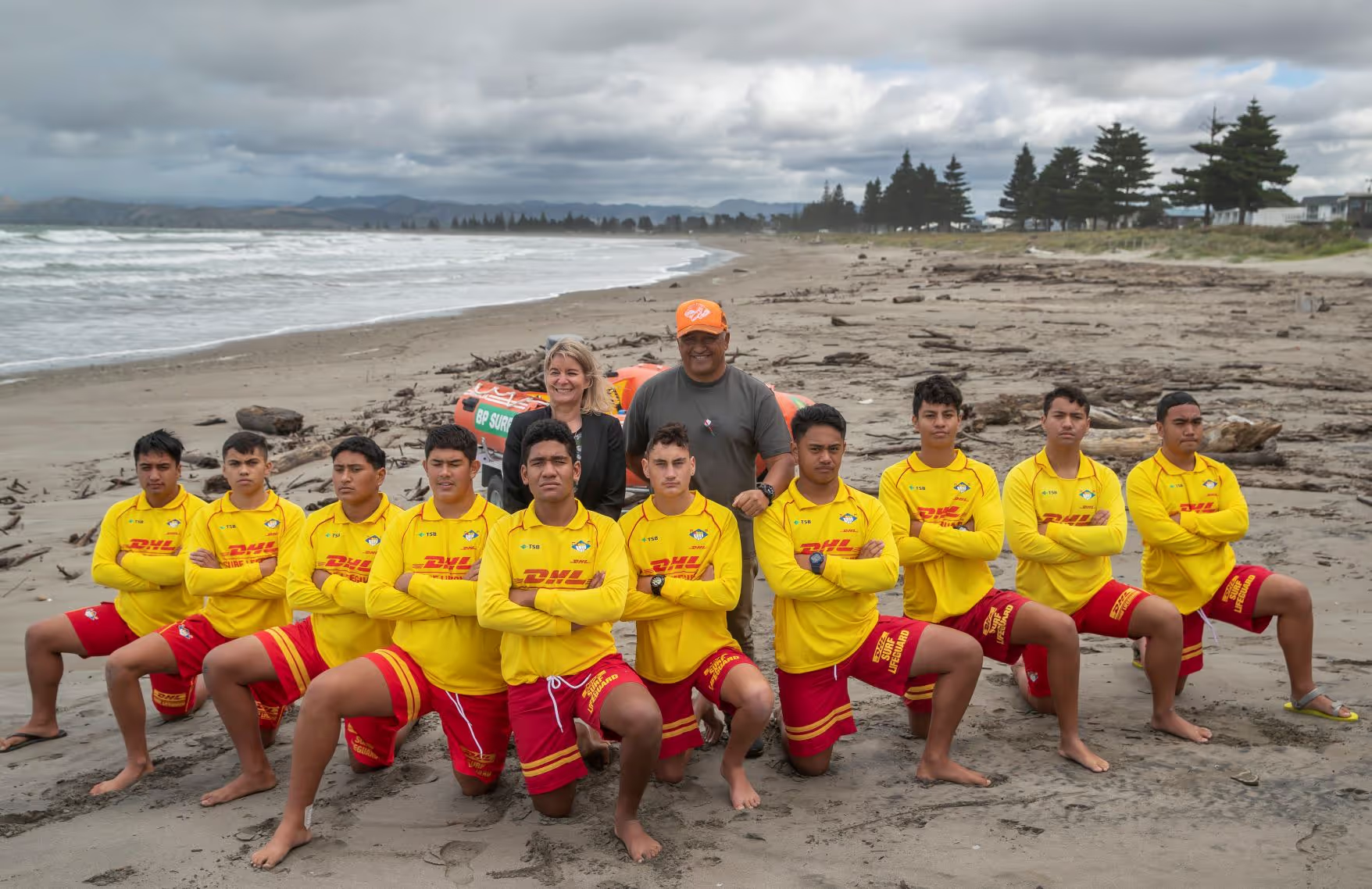
Whiria te tangata/weaving the people together – the theme of Volunteer Week 2019 — perfectly describes the strength underlying lifeguard Peter Boyd’s work building a new surf lifesaving club for his isolated East Coast community, founded on kaupapa from Ngati Porou and Surf Life Saving New Zealand.Peter is the founder and club coordinator of the country’s newest surf lifesaving club, the Ngati Porou SLSC, which patrols the remote Onepoto Beach in Hicks Bay, the northernmost beach on the East Coast.Peter became a volunteer lifeguard at Wainui SLSC in Gisborne, and loved it.“My family were surfers and were always in the ocean, so I was asked to be a lifeguard when I was 17 in 1984,” he says.In his 26 years with Wainui SLSC, he carried out regular patrols, became part of its governance committee, and represented the club in surf lifesaving sports.He also took part in the nationwide resurgence in waka ama, and realised his East Coast community needed lifeguard services to keep them safe doing waka ama, collecting kai moana, fishing and swimming.“I could see in Surf Life Saving NZ the water safety message and the skills we needed in our community were already there.”Now, the club’s members patrol during summer, and train year-round in water safety, rescue techniques, first aid, leadership and teamwork, as well as running a Nippers programme for children.The club provides opportunities for young people to gain leadership experience and valuable skills.
They have also formed a partnership with the local kura kaupapa, whose teachers are becoming lifeguards and teach lifeguard skills through the club as part of the school curriculum.“One of the ancestors Ngati Porou came from is Paikea, the whale rider, he was an expert in the sea and he had to make sure he was safe in the sea.
You could say he was the original East Coast lifeguard.”The decision to call the club Ngati Porou Surf Life Saving Club, rather than Onepoto SLSC, as is convention, was an important one.“The reason for calling it Ngati Porou Surf Life Saving was it wasn’t a name isolating us to Onepoto Beach, rather it opened us up to within the whole Ngati Porou area.
It was a cultural and strategic move.“The club is open to everyone, and serves everyone, and this opens the door to those descended from Ngati Porou.”The club has been founded from the beginning with the intention to come towards surf lifesaving from a cultural perspective, he says.“It’s taken a little while for the idea of lifeguarding to catch on in our iwi – because the idea is seen as a mainstream Pakeha thing.“But I say it is us.
Because of our ocean culture.
We’re not just people of the land, we’re people of the sea, and respect for the sea and lifeguarding and safety are who we are.“It’s culturally more inviting - we can draw down on our cultural connections for Ngati Porou.
We have a thousand year history with the ocean.”Peter says the surf lifesaving movement’s mission to serve the community melds strongly with traditional Māori ideas about serving the community.“We have a saying – we say ‘we have the whānau, hapu, iwi – it’s always about the collective’.“We’ve qualified 18 new guards this season.
And I’m seeing our young people that we trained win awards and grow, and seeing people enjoying the ocean as a way of life.”Ngati Porou SLSC now has over 25 members, aged from 14 to 66, and helps patrol nearly 200 kilometres of East Coast/Tairawhiti coastline, working closely with neighbouring clubs in the district, Gisborne and Tolaga Bay.During summer there is an influx of visitors to the beaches, who swim, surf and enjoy boating, but often aren’t familiar with local conditions – a big challenge for a small surf lifesaving club.Last summer Peter and his nephews pulled four festival-goers out of a rip, and a nephew used a surfboard to rescue another who was drowning.Peter is heavily involved in the day-to-day running of the club, and carrying out patrols.
Right now he is gearing up for the winter training season, including an IRB (inflatable rescue boat) training camp for the district, that the club is able to participate in thanks to the donation of a new IRB from BP in April.“It feels great to know the skills you have, have been able to save people’s lives.
You feel proud,” Peter says. “It’s a wonderful thing, knowing that those skills are going into the community.”Peter BoydinNgati Porou Surf Life Saving Club
Interactive Volunteer Stories Map
This story was shared as part of our interactive map of volunteer stories from across Aotearoa, which we launched during #NVW2019.
This map is filled with stories from volunteers throughout Aotearoa, New Zealand.
This map celebrates the contribution of volunteers in their communities throughout Aotearoa.
It aims to inspire people to engage in volunteering, Mahi Aroha and social action and to realise the benefits of weaving their communities together through their actions.
Diversity
Inclusion
Volunteers
Youth
Connecting students to the community
When I first arrived at Victoria University of Wellington from India, I didn’t know anyone.
As an international student, I was on the lookout for a community to join that I was both passionate about and could help me meet new people.
I started to look at volunteer roles through the Victoria Plus Programme as a way to connect and make friends.The IHC one-to-one friendship programme seemed like the perfect fit for me.
I knew that I would be paired with someone who needed a friend and I needed a friend as much as they did.
I was able to support my buddy with everyday tasks and have lots of fun.
One day, my buddy wanted to make Nankhatai (an Indian biscuit) but the problem was I had never made it before!
We tried it together and everyone in the centre loved it.Another volunteer opportunity that caught my eye was the Fruit and Vegetable Co-operative at Victoria University of Wellington.
The Co-operative distributes fresh and affordable produce across the University’s campuses each week, contributing to a healthy food environment for staff and students.
The Co-operative could not function without the support of its volunteers, who help collect, pack and distribute orders.

Volunteering is not a job that you have to do.
It’s something that you are so passionate about that you want to do it.
I joined the Fruit and Vegetable Co-operative as a volunteer because I understand the important role accessible fresh fruit and vegetables play in health and wellbeing.
Put simply, I believe in what the Co-operative stands for.My first volunteer role was as a packer.
Fruit and vegetable orders are packed up for collection every week - we unload the produce from the delivery trucks, set up the tables, and pack all of the orders ready for collection by our members.
The pack out reminds me of a movie in which Santa’s elves in the North Pole worked together to pack Christmas gifts for children.
There’s a real sense of excitement as we work together as a team, enjoying ourselves throughout the process.
We play music, we chat, we are one big diverse community.After some time as a packer, I became the Pack-out Coordinator and then later moved on to do the accounts, which complemented my studies in Accounting.My other volunteer roles included being a Buddy for International students and a Residential Assistant at the University’s Willis Street Hall.
In these roles, I was able to share my own experiences with other international students new to New Zealand.
I also volunteered for Trade Aid because, being from India myself, I have seen the problems that small-scale artisans face when it comes to selling their produce and I really wanted to be able to support them in any way possible.My volunteering helped me achieve the Victoria Plus Award alongside my Master of Professional Accounting.
This was great recognition for doing something I enjoy.
Ankita ParmarVictoria Plus Programme
Interactive Volunteer Stories Map
This story was shared as part of our interactive map of volunteer stories from across Aotearoa, which we launched during #NVW2019.
This map is filled with stories from volunteers throughout Aotearoa, New Zealand.
This map celebrates the contribution of volunteers in their communities throughout Aotearoa.
It aims to inspire people to engage in volunteering, Mahi Aroha and social action and to realise the benefits of weaving their communities together through their actions.
Inclusion
Volunteers
Youth
Helping young people get through tough times
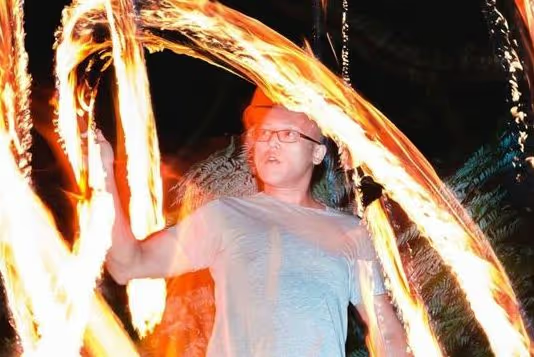
Andrew Pang has been volunteering at Youthline Wellington since December 2016.
Already working as a counsellor as his day job, his Youthline role has enabled him to further his passion for working with young people.As well as phone counselling, he has helped out with peer supervision and represented Youthline at events and fundraising.
He values the support, learning, and connection he gets from the peer supervision group, and says the volunteers of Youthline are generally a bunch of caring and wonderful people.Does he feel like he is making a difference in young people’s lives with his Youthline work?
“Yes!
So many calls, texts, and emails.
The most obvious ones are when someone is at risk and you provide essential support for them to get through a tough time.
Less obvious ones are when you help someone reflect on their situation so that at some point when they feel able to, they can make a proactive decision to make a positive change in their life.”Andrew enjoys working at Youthline and encourages others to join in volunteering.“Youthline has been a very rewarding experience and I’ve met so many amazing empathetic people through it.”Andrew PangYouthline Wellington
Interactive Volunteer Stories Map Launched
For NVW, Volunteering New Zealand has launched an interactive map of volunteer stories from across Aotearoa.
This map is filled with stories from volunteers throughout Aotearoa, New Zealand.
This map celebrates the contribution of volunteers in their communities throughout Aotearoa.
It aims to inspire people to engage in volunteering, Mahi Aroha and social action and to realise the benefits of weaving their communities together through their actions.

Inclusion
Mahi Aroha
Volunteers
Spreading joy through waiata and ukulele
Ki a Maatau Kaumatua aroha Kua Pahure nei, Ka Mahara matou ki a koutou ake ake — To our beloved kaumatua who have passed on, we will remember you all ake ake.“Arm in arm, we are knitted together.”Those are the words of the Te Puna Waiora Ukulele Group – a rōpū of kaumatua who have come together to spread joy; to sing, to play the ukulele and to just have fun!
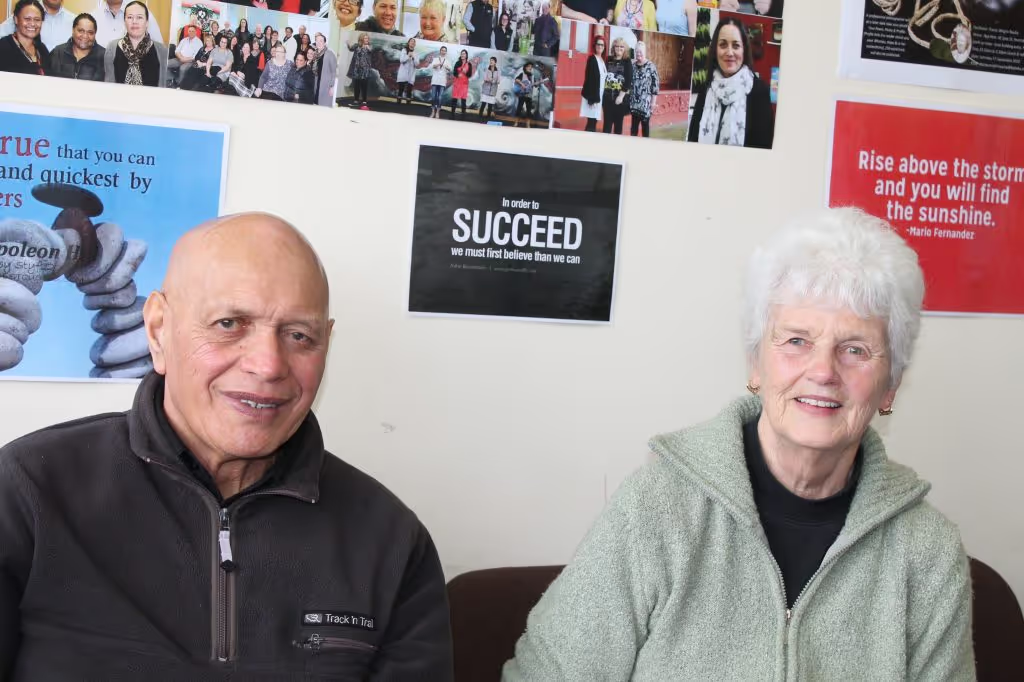
It started at Tauira Tautoko Student Support Centre at the Southern Institute of Technology in 2012.
Tauira Tautoko Kaimahi Marcia Te Au-Thomson, on behalf of Nga Kete Matauranga Pounamu CEO Tracey Wright-Tawha, had a korero with the late whaea Nan Ngatai, who was interested in a bit of awhi at the centre.
Nan was intent on bringing waiata and joy with her and from the moment she arrived she would jam away on her ukulele with her friend Whaea Isabel.Whaea Wini, who was teaching raranga at both Te Wānanga o Aotearoa and Southland Institute of Technology, heard the pair playing through the (clearly very thin) walls and told Aunty Billie.
Before long a large group was beginning to form at Tauira Tautoko each week.
They now sing and play and have a great time together, and generally enjoy a cup of tea while they’re at it.
There are no rules!“We just love to sing and be together.
We’re like one big family and this is the home where we can all gather,” one member says.At one stage there were 21 members - the youngest was 57 and the oldest was 92.
Everyone had ukuleles and they were rocking the house!People are always hearing about the group from others and with no criteria to join, new members are often showing up for a sing-along.The group meet and perform at Tauira Tautoko every Wednesday around lunch time, but they also enjoy entertaining the public at rest homes and community events such as festivals and the Bluff Triathlon.
The group has even braved some wet, wintry days with rugs draped over their legs while performing on the streets in Windsor at market days.They say the ukulele is easy to play – there are tons of songs with just four notes.
It doesn’t matter whether you’re a top notch singer or a seasoned ukulele player – the group holds no bias.
It’s more about the music, the comradery, the company of others and just a good catch up over the teacups.“We just all love to sing and be together.
If you want to play, then play.
If you want to sing, then sing.
It doesn’t matter, as long as you’re enjoying it,” one member explains.The group says the crowds seem to enjoy their performances and often sing or clap along.Nga Kete Matauranga Pounamu CEO Tracey Wright-Tawha says that the beloved kaumatua offer more than the joy of music.“They demonstrate love and care for fellow man, share themselves, connect people and create a place of unity.
They give generously of their time and energy and are completely selfless.
I love being in their company and always feel better for the opportunity.”Te Puna Waiora Ukulele GroupInvercargill
Interactive Volunteer Stories Map
This story was shared as part of our interactive map of volunteer stories from across Aotearoa, which we launched during #NVW2019.
This map is filled with stories from volunteers throughout Aotearoa, New Zealand.
This map celebrates the contribution of volunteers in their communities throughout Aotearoa.
It aims to inspire people to engage in volunteering, Mahi Aroha and social action and to realise the benefits of weaving their communities together through their actions.

Leadership
Volunteers
Youth
Guiding the next generation through volunteering
I grew up in a market town outside of Cambridge, England, moving to New Zealand in 2005.
I went to four different primary schools, two high schools, and two different universities.
The one constant through all this time was Guiding — a regular weekly meeting where fun was to be had, stories were shared, and skills were gained.My journey as a volunteer with GirlGuiding started during my first year of NCEA, when I began helping a local Brownie group.
My goal?
To tick off enough hours to complete my community service requirements, and then depart so I could focus on my schoolwork.
After a year, I had signed up as a permanent volunteer.The reason for this change in mindset was simple: the girls.
They make you smile when you’re not feeling your best, their world is full of creativity, and anything is possible.
To be part of their journey, and to encourage them to reach their dreams is an incredible vocation.
Working as a volunteer helps to weave our local communities together.
It builds a network of relationships between our girls, parents, volunteers, and other members of the community who help out – through sponsoring events and gear, or simply by buying a packet of our well-loved biscuits.As I continued with the Brownie group, I also started helping a local Guide group in a neighbouring suburb.
Balancing these two commitments meant I learnt more about time management, confidence, and communication, as well as focusing on my first year of university.Without Guiding, I wouldn’t be who I am today.
As a volunteer, I was challenged not just in my adolescence, but as I emerged into adulthood as well.
How was I supposed to deliver a programme on body confidence if I myself had insecurities with my body image?
It enabled me to look at myself in a new way, and better support my girls in exploring their individuality and identity.

The highlight of my week are Wednesday evenings with my Rangers.
From the in-jokes to personal development, from leadership to astronomy, these girls lead the programme and I act as their facilitator on their personal journey.
It helps me feel close to my Grandmother, who was an avid member of GirlGuiding, and I want to build the same positive relationships with my girls and community that I was provided with as a girl.Bryony SmithGirl Guiding New Zealand
Interactive Volunteer Stories Map
This story was shared as part of our interactive map of volunteer stories from across Aotearoa, which we launched during #NVW2019.
This map is filled with stories from volunteers throughout Aotearoa, New Zealand.
This map celebrates the contribution of volunteers in their communities throughout Aotearoa.
It aims to inspire people to engage in volunteering, Mahi Aroha and social action and to realise the benefits of weaving their communities together through their actions.

Inclusion
Leadership
Research
The power and politics of volunteering
The power and politics of volunteering.
Volunteering is a powerful activity that can influence people’s lives, change attitudes, and even achieve political reform.
This power comes with many opportunities as well as immense responsibility.
In this blog post, I share some ways we might think about the power of volunteering, its relationship with politics, and how we can ensure we are being ethical and effective volunteers.Volunteering has a powerful role to play in filling service provision gaps that arise for a multitude of reasons:Some things cannot wait for government policies or “official action”.
It becomes up to each and every one of us to take up that challenge in the meantime.
Therein lies the social power of volunteering – the ability to take action when no one is quite ready or able to.
Many of us are volunteers because we are impatient – impatient to wait for others to act or for policies to change; instead, choosing to help now.
In the United Kingdom, I am involved with a charity attempting to promote greater educational equity across Oxfordshire.
In an ideal world, the government would invest far more resources into state schools, promote greater equality of opportunity across the population, and introduce a comprehensive strategy around achieving educational equity.
In our non-ideal world, where our leaders are unable or unwilling to act, volunteers have a role to play in helping those who struggle.
The act of volunteering in this context is powerful not only because we often have the privilege of making a significant impact on students who have been failed by the system, but because it sends a powerful message to others about the importance of educational equity.Volunteering is a powerful language:The social and political power of volunteering also comes from the fact that volunteering is a language that can send a powerful message to leaders, policy-makers, and others in the community.
When we act through our own volition and without expecting payment, we send a vastly different message than when we do something because we are obligated and paid to.New Zealand abounds with countless examples of the power of volunteering being harnessed to advance social justice: environmental action and protests against climate change, the campaign for marriage equality which saw thousands take to the streets in support, Te Puea marae hosting dozens of homeless families and helping them into housing, and numerous other examples.
What is clear about each of these campaigns is that had the actions not been carried out voluntarily – by volunteers – the impact and the message would have been very different.
The political change that arose as a result of those actions happened precisely because they were undertaken in a voluntary capacity; because people chose to freely contribute their time, energy, and skills (in vast displays of strength and number) to make a statement of justice rather than doing so because they had to; and because they drew on the language of volunteering.The language of volunteering is an inevitable statement that when we do something for free, it is because we value and care deeply about that ‘something’.
If those social campaigns were merely undertaken by people who were paid to march in the streets, it would not have had anywhere near the same magnitude of social impact.
This is what makes activism different from lobbying.
The activist is driven by passion and altruism, while the lobbyist is driven primarily by money or other pecuniary considerations.Volunteering is never a politically or morally neutral act:While the social and political power of volunteering means it can be harnessed for great things, we should also be attuned to the ways it can be used in ways contrary to our goal of improving welfare and achieving social justice.Volunteering is often a complicated balance between filling an urgent service- provision gap now and ensuring that we do not dis-incentivise political institutions from dealing with more structural issues.
A practical step I advocate is thatorganisations doing ground-level volunteering (that is, volunteering based on grassroots service provision) should always be accompanied by strategic political activism that deals with wider socio-political factors.The case of homelessness is an excellent example.
While there are many organisations doing fantastic work helping the homeless on our streets, it is vital that they simultaneously advocate for more substantive, longer-term, upstream solutions.The rights and welfare of the homeless should not depend on charitable contingencies or the coincidental goodwill of volunteers; it should be guaranteed by the state as a matter of justice.
In this context, volunteering has a very important role to play, but it must be accompanied by strong political activism and structural reform in order to be ethical and effective.We often join volunteering causes because we feel a strong emotional connection.
While this may be understandable, we must always be cautious about the way these intuitions and emotive forces have been shaped.
For example, many people feel a stronger connection to causes closer to home, involving their compatriots.
While community ties are of course important, we must also not forget that these intuitions about helping our compatriots have been shaped in a particular socio-political context.
This socio-political context may have unjustifiably influenced us to think about “our own” at the expense of those who are not seen as “us”.When we volunteer, we must reflect not only on our actions but on our inactions.
We must make sacrifices about what we devote our limited time and resources to, but we must always be critically reflective about our reasons for committing to a particular cause, and whether we ought to broaden our volunteering horizons beyond just helping those we see as being like “us”.
Volunteering is not just about what we do, but also what we don’t do.Because volunteering is inherently political, it may compel us to ask very difficult questions of ourselves.
Is working with this particular charity the most effective and equitable way I can contribute my limited time and resources?
Is my volunteer work dealing with upstream, structural factors or am I merely part of the ambulance at the bottom of the cliff?
Why am I really volunteering for this charity, and am I doing it for the right reasons?
Can I do more good elsewhere?
Is my volunteering work helping to achieve social justice?Volunteering is not just good or beneficial or fun or rewarding: it is also powerful.
As volunteers, I have no doubt that you are committed, passionate, wonderful, and caring people; but do not forget: You are also powerful.
With that power comes an immense ability and responsibility to care, reform, and critically reflect.Volunteering is usually most ethical and effective when grassroots compassion is accompanied by vocal political activism and the pursuit of wider structural reform.
- Johann Go. Volunteering New Zealand's Programme Advisor - Strategy.
Further reading and resources on volunteering:

Campaigns
Diversity
Inclusion
Volunteers
Celebrate Microvolunteering Day 15 April
Micro-volunteering is bite-sized, on-demand, no commitment actions that benefit a worthy cause. Micro-volunteering is quick and convenient – a micro-volunteering opportunity might take less than two minutes to complete and in some cases can be done from the comfort of your couch in your pyjamas.
Microvolunteering allows more people to give back to their community and complements, rather than replaces, traditional forms of volunteering.
A key benefit of microvolunteering is that it provides a space for those who wouldn’t otherwise consider volunteering, or be able to.
Predictions from the Institute of Volunteer Research’s (UK) are that the need for microvolunteering will only increase with time.In the last few years a phone app has provided invaluable assistance to people around the world.
Be My Eyes links blind and vision-impaired people to sighted volunteers in an on-demand app service.
The way the app works is by enabling live video on the sight-impaired person’s phone and beaming what they can’t see to a volunteer to describe; whether it be identifying the expiration date on food packaging, describing a picture or finding a lost earring.
Katie Bruce, VNZ’s Chief Executive is just one of these sighted assistants and last week supported someone to apply make up for their wedding anniversary date.
Katie says that "being able to be there for someone exactly when they need it is a real privilege.
A conversation that might only be a couple of minutes can be a real highlight of my day".
She has tapped into a new and flourishing form of volunteerism, one that could have only been born in the fast-paced busy world of today: Microvolunteering.
Celebrating Microvolunteering April 15, every year
April 15 marks Microvolunteering Day when volunteering is recast as an activity that needs not be constrained by stereotypical views of volunteering being a time and commitment intensive activity.This is an internationally celebrated day that takes place on 15th April every year.
Organised by Help from Home, it is a unique opportunity to demonstrate the power and potential of the microvolunteering concept.Celebrating Micro-volunteering day is a chance to recognise new and different ways to involve volunteers within organisations.
Last year we released a collation of Virtual Volunteering resources during lockdown.
We have also found this great resource about creating micro-volunteering action plan: How To Develop a Microvolunteering Action: A guide for Charities and NonProfits.Celebrating it as a community is an opportunity to inspire individuals to engage in microvoluntering tasks and to inspire organisations that involve volunteers to embrace the idea and find ways to offer opportunities for individuals to connect or contribute to their cause.Microvolunteering Day is also a unique opportunity for microvolunteering platforms, volunteer involved organisations and individuals to join together in a synchronised effort to demonstrate the empowering potential of the microvolunteering concept.
What makes Microvolunteering unique?
Micro-volunteering tends to take place online (more than 80%, a 2016 study by Help From Home, a business that pairs people with micro-volunteering tasks, found) and the volunteers are often spread across a wide geographical area.
Microvolunteering has three specific features:
- typically there is no application or training process
- the volunteer-tasks take generally no more than 30 minutes to complete and
- there is no expectation of an ongoing commitment between organisation and volunteer.
Microvolunteering may also be called ‘byte-sized volunteering’, ‘speed volunteering’ and ‘micro-actions’.Want to do some Microvolunteering right now?
Why not check out Toko – New Zealand’s people powered petition platform.
Start your own campaign or support a campaign.Or if you have a couple of minutes to spare you could promote the upcoming National Volunteer Week 16-22 June 2019 to your networks by sharing our downloadable resources.Michelle KitneyVolunteering New Zealand

Inclusion
Recognition
Views
Volunteers
VNZ Video: Saving New Zealand's Birds
Saving New Zealand's Birds.
This video documents Barry, a volunteer who dedicates his time to conservation efforts in his local community.
Barry's message is heartfelt, highlighting that everyone has something to offer through volunteering.
This video was produced by Amelia Blamey, VNZ Community Engagement Advisor.
Our natural environmental is an integral part of New Zealand’s identity.
Informing how we look at the world and interact with others.
We are blessed with pristine beaches, lush bush and snow capped mountains.
The preservation of these natural wonders is no small feet and is in no way ensured.
It is the result of thousands of hardworking New Zealanders tirelessly working to ensure its protection.
Our ongoing fight is a necessity to protect our heritage, culture and identity; all of which is intrinsically linked to our natural environment.
The purpose of my video was to provide insight into dedication and the hard work of our volunteers, especially those who operate behind the scenes.
I hope that it highlights the fact that everyone has something to offer to the world and that every has a responsibility to preserve what is good in it. This video was launched during Conservation Week I Te Wiki Tiaki Ao Turoa as our way to acknowledge the incredible effort of conservation volunteers.Amelia Blamey, VNZ Community Engagement Advisor

Amelia is studying towards a Bachelor of Commerce, with majors in Finance and Marketing, and minor in Film.
She hopes to use her passion for storytelling to raise awareness and encourage activism in her community.VNZ Resources:
Inclusion
Research
Views
Volunteers
Diversity: Volunteering for People with Disabilities

Volunteering for People with Disabilities
Public discourse overwhelmingly frames people with disabilities as receiving help, rather than providing it.
This is a problem for several reasons:
- It is incorrect.
- A study conducted by Carrie L.
- Shandra in the United States indicated that people with disabilities are just as likely as people without disabilities to report informal volunteering.
- This is voluntary work outside of a formal organization—for example, helping an elderly neighbor with cooking.
- A copy of Shandra’s paper “Disability and social participation: The case of formal and informal participation” can currently be found on the Volunteering New Zealand website.
- It influences volunteering organisations to overlook the potential for people with disabilities to volunteer in a way that is compatible with their disabilities.
- It discourages people with disabilities from seeing themselves as people who can help others.
- This in turn discourages people with disabilities from contacting organisations about opportunities to volunteer.
People with disabilities are significantly underrepresented as volunteers with organisations.
Shandra identifies ableism as being the most important barrier to people with disabilities participating in formal volunteering.
On the one hand, organisations often choose applicants without disabilities, rather than applicants with disabilities, to fill certain roles, without fully considering whether the disabilities in question would have affected the applicants’ abilities to perform the roles.
On the other hand, organisations often do not know how to recruit for volunteers in a way that reaches people with disabilities.This is unfortunate, because volunteering is positively correlated with happiness, life satisfaction, self-esteem, psychological well-being, and self-reported health.
Liat Kulik conducted a study of 160 people in Israel with physical disabilities, including some who did not volunteer, and some who did volunteer.
The participants who volunteered reported significantly higher self-esteem than the participants who did not volunteer.
In particular, Kulik noted that participants from lower socio-economic backgrounds especially reported higher self-esteem than their non-volunteering counterparts.
A lot to gain by volunteering
Volunteering also helps people to meet other people—this increases their opportunities to make friends, find employment, and engage with their communities.
Most of the participants in Kulik’s study agreed that Volunteering was an effective way to make new friends.
People with disabilities, like people without disabilities, stand to gain a lot by being able to volunteer.
In many cases, a person with a disability can perform a volunteer role in the same capacity as a person without a disability.
In other cases, a person with a disability can perform a volunteer role in a modified capacity that is appropriate to his or her individual condition.Of course, it is a positive thing that there are many services and organisations built around providing help to people with disabilities.
Disabilities can affect people’s quality of life, and people with disabilities often do need and want help.
However, it is important that society see people with disabilities as people who can both receive help, and provide help, like people without disabilities.
A person who is willing and able to perform a volunteer role with an organization must not be held back just because they have disability.
We must find imaginative ways of enabling people with disabilities to volunteer in ways that are appropriate to their individual conditions.

Author: Lucas Davies Lucas is writing a series of blogs posts and articles for Volunteering New Zealand, with a focus on research articles. Article References:

Carrie L.
Shandra Disability and Social Participation: The Case of Formal and Informal Participation (Social Science Research 68 (2017) 195-213) published online 2 March 2017, retrieved 4 April 2018.

Liat Kulik. Through Adversity Comes Strength: Volunteering and Self-Esteem Among People with Physical Disabilities (Voluntas DOI: 10.1007/s11266-017-9914-5), retrieved 29 April 2018.Volunteering New Zealand Research and Resources:

- Competencies for Managers of Volunteers
- Research on disabilities and volunteering
- LeadMe - free online self-assessment tool to assist you to create better outcomes for your organisation's volunteers
Advocacy
Leadership
Opinion: Volunteering in Aotearoa New Zealand - A Decade of Change
This opinion article is one in a series of responses by thought leaders in response to our State of the Decade of Volunteering report. Professor Karen Smith is Professor, Te Herenga Waka | Victoria University of Wellington and Chair, Volunteer Wellington | Te Puna Tautoko.
This opinion article is one in a series of responses by thought leaders in response to our State of the Decade of Volunteering report. Professor Karen Smith is Professor, Te Herenga Waka | Victoria University of Wellington and Chair, Volunteer Wellington | Te Puna Tautoko.
Volunteering in Aotearoa New Zealand: A Decade of Change
The past decade has included a global pandemic, major demographic change, regulatory reform, and profound shifts in how people live, work, and connect. The fact that volunteering in Aotearoa New Zealand remains resilient in this context is, in my view, remarkable.
The State of the Decade of Volunteering report is an important piece of work that helps us understand how volunteering is changing, and what that means for us as a sector. When the first State of Volunteering research was published, I wrote about the importance of having robust and accurate data on volunteering to guide how organisations attract and support volunteers, as well as to inform government policy and investment in the community and voluntary sector. That still holds. What has been harder is ensuring we have local research that reflects the diverse ways volunteering is experienced and organised in Aotearoa New Zealand.
This is why Volunteering New Zealand’s sustained leadership in building what is now a valuable longitudinal evidence-base matters so much. The sector now has the rare ability to look across a decade and see not just what has changed, but what has endured.
Here, I focus on three findings that resonated strongly with me as a university academic researching volunteer leadership and management, as Chair of a volunteer centre, and through a long‑standing belief in the power of volunteering to strengthen communities.
1. The perception–data gap in the state of volunteering
Organisations consistently report that volunteering is declining and that recruiting volunteers has become harder. Sector‑level data, however, shows stable or increasing participation in volunteering.
The Decade report brings this perception gap into sharp focus. It is not an error in the data; rather, it reflects a mismatch between how volunteering is counted, how it is organised, and how it is experienced on the ground.
Many organisations are feeling the effects of fewer hours per volunteer, greater casualisation, and rising demand for services. That can feel like decline even when overall participation remains strong. From a research perspective, this reinforces the need to recognise different forms of contribution, including informal, episodic, and culturally grounded volunteering that sit outside traditional organisational models.
This is where plural ways of knowing and counting really matter. The Contributions of Tūao Māori report (one of the State of Volunteering publications) is a powerful example of what becomes visible when different frameworks shape how volunteering is understood. At Volunteer Wellington, insights like these are informing work such as the Te Aka Tūao initiative at Volunteer Hutt, where volunteering is approached as relational, place‑based,and embedded in community life.
2. Growing professionalisation, without proportional resourcing
Volunteer leadership roles are becoming more complex and demanding, but resourcing, support, and recognition have not kept pace.
Across the Decade report, the steady professionalisation of volunteering stands out. Expectations around compliance, safeguarding, inclusion, cultural competence, risk management, recruitment and reporting have all increased. These expectations fall most heavily on those who lead and coordinate volunteers, whether they are paid staff or volunteers themselves.
This finding aligns closely with my own research, but what the Decade data makes especially visible is how much systemic risk is being absorbed by those in volunteer leadership roles. When resourcing does not scale with responsibility, pressure accumulates in individual roles. Burnout then shows up not only as a personal issue, but as a signal that systems are stretched.
For organisations and for the sector, this raises a practical question: how are we valuing, supporting, and sustaining volunteer leadership roles so that professionalisation strengthens volunteering, ratherthan undermining it?
3. Digital tools and the uneven pace of change
Digital tools have long been described as an opportunity for the volunteering sector, however, adoption across the decade has been slow and uneven.
The Decade report shows that, despite wider technological change in society, the use of digital tools to support volunteering has shifted only marginally. For many volunteering involving organisations, when technology has been adopted, it is often limited to recruitment or basic administration rather than reshaping how volunteering is organised.
This matters because flexibility now sits at the heart of participation. Digital tools can support shorter commitments, remote and micro‑volunteering, and more responsive matching between volunteers and roles. From an organisational perspective, technology can also make it easier to track contributions, understand impacts, and tell the story of volunteering to funders and policymakers.
In my volunteer centre governance role, I am acutely aware that digital change carries real costs and capability demands. What the data suggests is not a lack of will, but a gap between aspiration and support. Without deliberate investment and shared approaches, digital unevenness risks reinforcing existing pressures rather than easing them.
Concluding thoughts
The Decade report shows a sector that remains resilient while operating under growing strain. Volunteering continues to play a vital role in our communities, even as the conditions that shape participation, leadership, and impact are shifting.
For practitioners, funders, researchers, and policymakers alike, the challenge of the next decade is to respond deliberately to what the data is telling us. The strength of the sector lies in its capacity to adapt; ensuring that adaptation is informed by evidence will be critical to the health of volunteering in the years ahead.
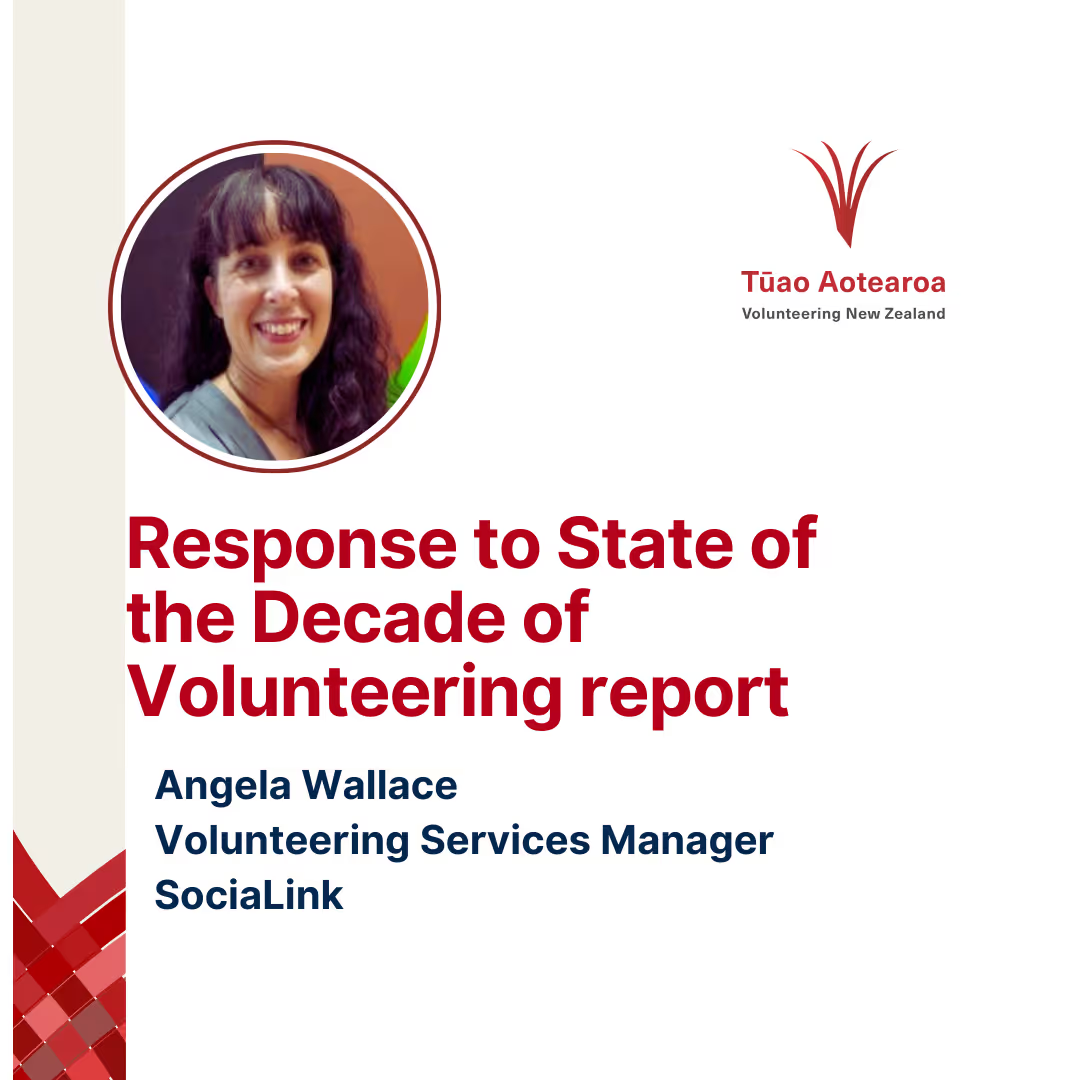
This opinion article is one in a series of responses by thought leaders in response to our State of the Decade of Volunteering report. Angela Wallace is the Volunteering Services Manager at SociaLink, (in the Western Bay of Plenty).

This opinion article is one in a series of responses by thought leaders in response to our State of the Decade of Volunteering report. Angela Wallace is the Volunteering Services Manager at SociaLink working to grow and support volunteering across the Western Bay of Plenty.
As a manager of a volunteer centre, I’m often asked how I think volunteering is faring in our busy and pressured world. There are very real challenges: the rising cost of living, people juggling multiple jobs, growing individualism, and increasing social isolation.
And yet, despite all of this, I believe volunteering in Aotearoa is not only holding steady – it is thriving. More than that, volunteering offers us a pathway through many of the challenges we face as communities today. It is one of the ways we pull together, working shoulder to shoulder for something bigger than ourselves.
With 2026 designated as the International Volunteer Year, Volunteering New Zealand’s State of the Decade of Volunteering report gives us timely and valuable way markers. It helps us understand what hasc hanged, what has endured, and where we need to focus our collective effort if volunteering is to remain strong, visible, and valued into the future.
Here’s what stands out to me.
Volunteering is strong
The Decade report shows that more people are volunteering in Aotearoa than ever before. While individuals may be contributing fewer hours on average, more people are giving small but regular amounts of time.
The recent International Volunteer Day theme, Every Contribution Counts, could not be more fitting. When volunteering is spread across more people, the benefits ripple outwards.
Each volunteer connects with a cause. They build relationships and friendships. They rub shoulders with people who can be very different from themselves. They gain skills, confidence, and insight – and invite others to join them in the mahi.
The impact is wide-reaching: stronger social connections, greater understanding of difference and diversity, and increased social cohesion across communities. And of course, there is the immediate and tangible benefit of the volunteer work itself for the organisations and causes being supported.
People want to play a meaningful part in their community
The report confirms what many of us see every day: volunteers are motivated by purpose. Today’s volunteers seek opportunities that align with their values, fit around their lives, and allow them to use or grow their skills.
When people care about their communities, communities thrive. While many volunteers may no longer be able to commit to long-term, regular roles, they are still deeply willing to give their time and energy when the opportunity feels meaningful and manageable.
This is where storytelling matters. Clearly communicating the purpose and impact of volunteer roles is key to engaging and retaining volunteers. When someone understands how their fortnightly two hours contributes to positive change, they are far more likely to keep coming back.
Take the volunteer at a local animal shelter. Much of their time may be spent cleaning cages and washing blankets, yet they return week after week because they know their effort helps animals feel safe, cared for, and ready for rehoming. That connection to purpose makes all the difference.
Adaptation is essential
This brings us to a clear challenge for volunteer-involving organisations: we must adapt.
As the Decade report reminds us, “The strength of Aotearoa New Zealand’s voluntary sector lies not only in its history, but in its capacity to adapt and innovate”.
The spirit of volunteering remains a cornerstone of community life in Aotearoa, but the ways people choose to volunteer – how, when, and why – are changing. Our roles, systems, and expectations need to reflect the realities of modern life.
We need to ask ourselves:
- How are we adapting our volunteer roles to meet the needs of today's volunteers?
- How are our practices becoming more flexible, responsive and welcoming for people who are time-poor, mobile, digitally savvy, and keen to contribute in purposeful ways?
The task ahead is not to recreate volunteering as it once was, but to recognise and support what it is becoming. The energy, care, and willingness are still here. The question is whether our institutions and practices are evolving to meet them.
We continue to value and appreciate the volunteers who form the civic core – those who give regularly, often for many hours, and stay connected to organisations for years. At the same time, the data tells us this group is shrinking as our population ages. We’re also becoming a more diverse and multicultural society. To sustain volunteering into the future, our approach must evolve, meeting new generations of volunteers where they are.
In this International Volunteer Year 2026, I feel genuinely encouraged by the commitment I see across our community sector: people stepping up to support those who are struggling, welcoming newcomers, and acting as kaitiaki for our whānau and whenua.
Volunteering has the power to bring people together, to repair what has been broken, and to build something stronger than the sum of its parts. There is a place for everyone who wants to show aroha to their community through volunteering.
He waka eke noa – we are all in this together.
Pick up a paddle! Let’s forge ahead in our waka.