
News
Stay updated with the latest from Volunteering New Zealand



Advocacy
Latest News
Leadership
Volunteers
Volunteer function critical to business

In recognition of International Volunteer Management Day on 5 November, Karmin Mudaly, National Volunteer Manager, Blind Low Vision NZ, reflects on the future of volunteering and how volunteer-involving organisations can embrace change.COVID-19 and the pandemic era has catapulted volunteering into the public eye, with the value volunteers provide shown publicly during times of crisis.
Organisations have now started to see volunteer functionality as a critical part of their business operation.This increased visibility has also proved the value of accurate data reporting and tracking of the volunteer function within businesses, which immediately demonstrates the value-add.
I have also noticed a shift in some corporate organisations that are now encouraging employees to engage in volunteer activities by implementing or increasing volunteer leave days.At Blind Low Vision NZ, volunteers are integrated throughout our organisation, from providing physical and virtual volunteer support, to working with AI technology.
We have also considered what the future of volunteering would look like to future-proof our volunteer function.
Key indicators included the importance of accurate fit-for-purpose data reporting and collation, proactively engaging with our diverse communities, collaboration, and effective communication.
We are committed to having a lasting, meaningful volunteer function within our organisation.I believe that the future of volunteering lies within an organisation/group’s ability to successfully incorporate the following:
- Organisational values
- Key priorities
- Collaboration
- Local community engagement
- Accurate data collection and reporting
- Onboarding and training
At our organisation, we are building upon 131 years of volunteering foundation, by offering a range of innovative types of volunteer opportunities.
We clearly identified the role our volunteers play within our organisation and the invaluable contribution they provide.We engage with diverse communities and have identified the importance of multi-lingual abilities within our volunteer group.
We have a proactive approach to engaging and managing our volunteers with a positive, easy, onboarding process, coupled with an opportunity-specific training plan.
Our organisation intends to enable the volunteer function to access the necessary business tools to make our future planning a success.Blind Low Vision NZ has placed itself at the forefront of future-proofing its volunteer function, by forward-thinking and embracing innovative ideas.Our approach includes:
- creating a pipeline for volunteer engagement
- multi-departmental collaboration
- co-designed volunteer opportunities
- proactive engagement with migrant and ethnic communities and other organisations
- developing key relationships within the youth sector.
The future of volunteering lies in engaging with all aspects of our communities’ demographics and by utilising the vast array of identifiable skills that our volunteers bring with them.

Join with your peers this International Volunteer Managers Day, 5 November to Shape the Future, Tāraitia te āpōpō.
Strong leadership guided the volunteer sector response to Covid-19 and will help us recover.
Together we can envision our future of volunteering, te wā heke me te mahi tūao.Volunteer trends were changing prior to the global pandemic, and have dramatically shifted since, especially seen in access to funding, changing demographics of volunteer recruits and regional differences.Volunteer managers responded with strategic leadership and created partnerships and collaborations to continue to thrive.
Now volunteer-involving managers and organisations need to build their resilience and connections to ensure volunteering is recognised as delivering vital services, as well as protecting the wellbeing of our society.
Volunteering New Zealand is advocating for a National Volunteering Strategy, as a bold, coordinated voice from the sector that acknowledges that we work across boundaries supporting our communities.
As we reimagine volunteering, we need to dream big and include everyone’s voices to help inform the future of volunteering in Aotearoa.
#IVMDAY21 – Start promoting today.Download:
- IVMDay Social post V01
- IVMDay Social post V02
- IVMDay social post – rectangular
- IVMDay social post – rectangular
- IVMDay Facebook banner
- IVMDay Twitter – rectangular
- IVMDay Copy – 50, 100, 200
Community
Diversity
Recognition
Social justice
VNZ Events
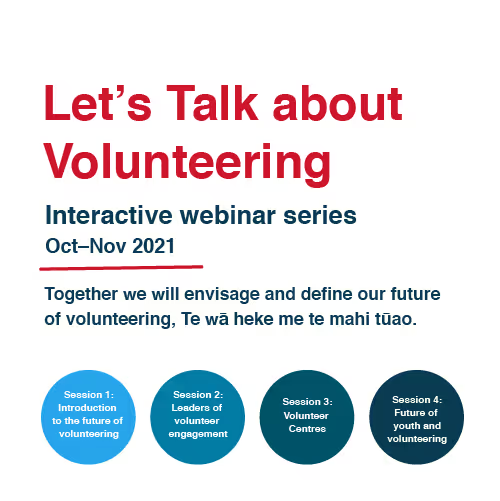
Let’s Talk about Volunteering: Future of Volunteering webinar series Oct - Nov 2021
Join us to Shape the Future | Tāraitia te āpōpō! in a series of interactive sessions facilitated by Volunteering New Zealand and Volunteering Auckland.In a series of three videos, leaders with a passion for volunteering from across the globe share their views on the future of volunteering in this post COVID world.
There are three key sessions with videos created by Volunteering Auckland to help us kick start a conversation.
We are also adding a fourth session on youth and volunteering.Join us to hear these insights, then contribute to a discussion about the future for volunteering in New Zealand.
Facilitated by Volunteering New Zealand and Volunteering Auckland.Together we will envisage and define our future of volunteering, Te wā heke me te mahi tūao.Let’s talk about volunteering
Volunteering New Zealand and Volunteering Auckland invite you to participate in a webinar series, Let’s Talk about Volunteering.
In a series of videos created by Volunteering Auckland, leaders with a passion for volunteering from across the globe share their views on the future of volunteering in this post COVID world.
Join the kōrero to hear these insights, then contribute to a discussion about the future for volunteering in New Zealand.
These free webinars will be held during October-November.
- Webinar 1: The Future of Volunteering, Thursday 21 October!
- If you missed it, watch the video below.
- Webinar 2: The Future of Volunteering - Leaders of Volunteer Engagement, Friday 5 November
- Webinar 3: The Future of Volunteering - Volunteer Centres, Friday 26 November
- Webinar 4: The Future of Volunteering - Youth and volunteering Friday 10 December
Get ready to join the korero
The State of Volunteering 2020 published in mid-2020 surfaced four key themes centred around diversity and inclusion, recognition and engagement, funding, administration, and compliance, strategy and management.A lot has changed since the start of 2020, and we have collated relevant COVID research on our website.
There are some other great findings and data that is worth reviewing:
- What is happening internationally with Voluntary Leadership Organisations.
- Older adults and volunteering in a Covid-19 environment.
- The latest research on younger people and volunteering.
- Look at some of our other webinars.
- Read this awesome recent research published by the Ministry of Pacific Peoples on Pacific Peoples unpaid work and volunteering.

Research
Volunteers
Wellbeing
Older volunteers affected by Covid-19 pandemic
Volunteering in an Ageing Population: research report Oct 2021People aged 65 or older are active volunteers, devoting triple the time on unpaid activities than people aged 12-24 years, says Volunteering New Zealand.Time spent volunteering provides a triple win, for the community, organisations and to the individual.Older people make a significant contribution to our communities through volunteering activities.
However, older volunteers and older adults were amongst groups that were significantly affected by the Covid-19 pandemic and lockdowns.Some older volunteers stopped volunteering, and some were prevented from volunteering because they have more life commitments (such as looking after grandchildren).
Although older volunteers can return to volunteering in lower alert levels, there is uncertainty about what this will look like in a post-Covid environment.Research by Volunteering New Zealand also showed that the effect of the Covid pandemic on volunteering includes:
- Regional differences have become bolder, and the demographics of some local communities are changing, including our volunteer demographics.
- Some community organisations have experienced an increase demand for their services, and funding is tracking as one of the biggest issues across the sector.
- Many organisations and volunteers embraced new technologies and online ways of volunteering.
Benefits of volunteering for older people
Looking more broadly at the extensive array of research on older adults and volunteering, there are significant wellbeing benefits that accrue to older adults through volunteering.The most common reasons older adults give for engagement in voluntary work are being helpful to others, “paying back” to society, and feeling a sense of obligation to the future generations.Volunteering can keep older adults active and socially engaged and may help them with some of the challenges (and opportunities) of retirement.
Research also shows that volunteering also has positive personal wellbeing outcomes for older adults who volunteer, including improved mental and physical health.Older volunteers report that volunteering provides:
- an opportunity to actively participate in society;
- expanded social networks and connection;
- and personal growth/ empowerment through learning new skills and knowledge.
Older adult volunteers consistently report an improvement in their quality of life resulting from feeling appreciated, having a sense of purpose, and giving something back to society.In the light of Covid-19 and its impact on older volunteers, Volunteering New Zealand recommends that:
- Some existing roles and activities be reworked to align with the new volunteering environment.
- This will ensure that older volunteers feel safe to return to the volunteering front line.
- Volunteer-involving organisations ensure they are inclusive, appreciative of older volunteers (amongst all volunteers), and impactful.
- For example, offer flexible roles matched to the skills, abilities and motivations of older volunteers.
Recognition
Research
Volunteers
Wellbeing
Recognising and celebrating Pacific unpaid work and volunteering
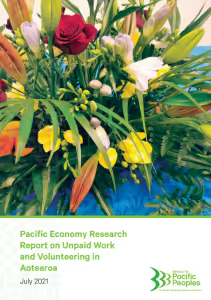
This report by the Ministry for Pacific Peoples - Pacific Economy Research Report on Unpaid Work and Volunteering in Aotearoa - captures Pacific peoples’ insights on volunteering and unpaid productive work.
Guided by Pacific research principles and methodologies, data was collected through focus groups, talanoa – discussion – and a survey.
It was launched in July 2021.
Recognising and celebrating Pacific unpaid work and volunteering
Research findings have revealed 97 percent of Pacific peoples spend around 66,035 hours per week on unpaid work and volunteering, equating to an average of 33 hours per week per person.Of this, 44 percent of Pacific peoples contributed a total of $2.4m of their own money to help others over four months, equating to an average of $161 per week per person.Covid-19 also impacted on unpaid work and volunteering for our pacific communities.
Over half of the survey participants reported providing increased social support during lockdown, while nearly 40 percent of participants reported increased caregiving for the elderly, providing administrative support, and serving as a cultural leader.Another key finding is that the current government economic measurements of Pacific contributions to the New Zealand economy are underestimated due to cultural differences in defining and measuring unpaid work and volunteering.
Community Luva - research launch
[caption id="attachment_35060" align="alignleft" width="391"]
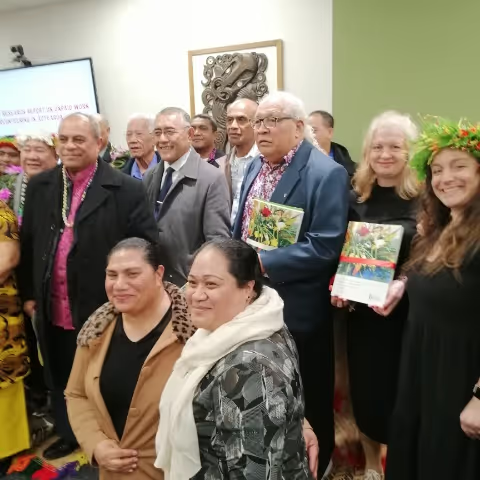
Chief Executive Michelle Kitney was gifted copy of Pacific Economy Research Report on Unpaid Work and Volunteering in Aotearoa on behalf of Volunteering New Zealand.[/caption]Volunteering New Zealand Chief Executive Michelle Kitney and Pacific Peoples Board Representative Cathy Aiavao attended the official Launch and Auckland Community Luva for the Pacific Economy Research Report on Unpaid Work and Volunteering in Aotearoa, at Manukau in August 2021.Key findings were presented at the launch and the research was gifted back to the participant communities.The research was presented by Hon.
Afioga Aupito Toeolesulusulu Tofae Su’a William Sio, Minister for Pacific Peoples.
Volunteering New Zealand was gifted the research as a friend of the Ministry of Pacific Peoples.Michelle KitneyChief ExecutiveVolunteering New Zealand

Advocacy
Community
Social justice
Volunteers
Volunteering can help mend ‘The Unspoken Epidemic’

By Ron RoweA community (a nation) is the sum of its parts.
Every part of every sector contributes in small or large measure to advance or regress the whole.
We all benefit from a society where people help each other.
People feel better if they help with a cause they believe in; and communities are strengthened.Currently, our nation is being wracked by an ‘Unspoken Epidemic’ of anxiety, uncertainty, and despair permeating many lives, created, or caused by the insecurity of the COVID pandemic.
This insecurity is being exacerbated by the ongoing and real problems within the wider health sector with all its ramifications – lack of doctors, nurses, ICU beds… mental health.
These are compounded by issues such as housing, poverty, child abuse, anti-social activities, economic uncertainty, immigration, and climate/environment.The decades-old societal band-aid is not having the desired effect.
This same tired old band-aid, whose stickiness has well worn off, is still being reused in an attempt to fix the ever-enlarging gaping wounds across all parts and sectors of our nation.
Many people are anxious and unable to see a positive future.
A bright beacon
Yet it’s not all doom and gloom.
Thankfully we do have a very bright beacon without which our communities would just not function well at all!
We have hundreds, thousands of organisations with a million or more caring people selflessly giving their time, and resources to contribute to their community.
Our nation of volunteers.Almost all community organisations rely on volunteers and without their work, much vital work for the community would not happen.
Volunteers are first responders in emergencies, working to conserve natural environments, and supporting vulnerable people in the community.The very large and effective volunteer sector can provide leadership to their communities.
We read and hear of many people taking the initiative and forging new and innovative ways in which to help their communities through the uncertainty.It could be said that volunteering continues to resurface the stickiness of the community band-aid.Volunteering does not happen by itself; people in community organisations must spend time and energy managing volunteers.
This includes recruitment, training, and recognising their work.
Volunteering New Zealand works with volunteer managers so they can do their jobs better.
Calling for a national volunteer strategy
Volunteering NZ is calling on people in government to recognise and promote volunteering by supporting a national volunteer strategy.
It will guide the development of volunteering and provide a roadmap for the future.
The community and voluntary sector, business and local government can all have input into the strategy and be responsible for the resulting actions.With a community being the sum of its parts, by collaborating, organisations can do more, go further and become greater in their efforts through the sum of each.Together, we can create a society that values volunteers as well as reaps the benefits of volunteering for wellbeing and social justice.About Ron Rowe: Ron has over 50 years of active leadership in several community-based and volunteer organisations both in NZ and Internationally.
Ron, a former Capability Development advisor, now retired, he has been a Lions club member since 1966.
Actively supported by wife Ngaire, in 1976 -1981 established the first NZ/South Pacific (MD202) secretariat for Lions Clubs.
Ron has recently brought together their voluntary activities in the book The Ever-Present Challenge – Empowering Volunteers and those who lead.

Community
Diversity
Research
Volunteers
Youth
SEEK Volunteer continues to grow and attract volunteers
SEEK Volunteer's vision is to connect more people to volunteering opportunities that enrich their communities, lives and careers.
In the last 12 months, SEEK Volunteer continued to grow its impact across New Zealand.
Given the challenges presented by COVID-19, it was pleasing to see both interest and connections of people to volunteer opportunities continue to grow.
SEEK Volunteer measures these by visits to the site and the number of people who submit an expression of interest form.
The following insights relate to 1 July 2020 – 30 June 2021.
Who is interested in volunteering and what are they interested in?
SEEK Volunteer connected 12,107 people to volunteer opportunities, this is up 9% when compared to the previous year.

The top 5 causes that people expressed interested in were -
- Community Service
- Health
- Young People
- Environment and Conservation
- Education and Training
Interest in ‘Health’ related volunteer opportunities grew the most, with an increase in expressions of interest up by 26% compared to the previous year. 34% of expressions of interest were from people under the age of 24 years old, 33% from those aged between 25-34 years old and 14% from those aged between 34-44 years old.
This highlights the strength that SEEK Volunteer has in attracting younger volunteers.
Females continued the trend of accounting for a large majority (76%) of all EOI’s.
What was on offer to those who wanted to volunteer?
SEEK Volunteer had 204 new organisations register to use the platform to recruit volunteers, this is an increase of 16%.
The top 3 regions these organisations were from included Auckland (72), Wellington (47) and Canterbury (26).
Over the course of the year, 1,971 unique volunteer opportunities were advertised.
The volume of opportunities at any single point in time stayed quite consistent sitting just below 1,000.
The top 5 categories looking for volunteers were -
- Community Service
- Young People
- Health
- Environment and Conservation
- Disability Services
Volunteer opportunities supporting ‘Young People’ was the biggest growing category with a 126% increase in volume.
There was an increase in remote and online volunteer opportunities, with 4% of all opportunities available to be undertaken remotely.
What’s next for SEEK Volunteer?
SEEK Volunteer experienced a 26% increase in visits this year.
To capitalise on this growing interest, SEEK Volunteer is working hard to increase the volume and breadth of volunteer opportunities available to prospective volunteers.
If you are interested in learning more about how SEEK Volunteer can help you recruit volunteers, please contact the team at: support@seekvolunteer.co.nz

Advocacy
Community
Views
Wellbeing
Kōrerotia, speak up! through our online survey.

Kōrerotia, speak up! through our online survey.
Let us know what has changed for your organisation since the pandemic began.
How are things looking?
How can we help?
This is a chance to remind our sector’s supporters and funders that the hau, or vitality, of our community organisations becomes the life force of our communities.
If you work with Māori, Pasifika, Ethnic or disabled communities, contact Hui E! to be part of a focus group.
Last year the Time to shine, time to take stock survey sought to uncover the effects of COVID-19 on the tangata whenua, community and voluntary sector.
The world did not stand still – and neither did you! For those who contributed to last year’s survey, kōrerotia, it’s time to speak up again. Complete this year’s follow-up hauora/wellbeing survey.
Volunteering New Zealand and Hui E! Community Aotearoa and want to know how your organisation is.
- What has changed or remained the same since last year?
- What are you doing the same or differently?
- How are your funding, staffing and volunteer numbers looking?
- How have you carried forward the best that came out of the first lockdown?
Click here to complete the survey, which will be open until August 13, 2021.

Community
Mahi Aroha
Volunteers
Tania Jones, Chair of Volunteering New Zealand, on the future of volunteering
For National Volunteer Week 2021, Tania Jones, Chair of Volunteering New Zealand, shared her thoughts on the future of volunteering.

“I want to first recognise and acknowledge all volunteers around Aotearoa.
No matter how you contribute, connect and give your time, we see you.
We recognise and acknowledge your mahi, your service.
Your gifts of time, of aroha, of effort.
We thank you, while we celebrate National Volunteer Week 2021 - Te Wiki Tūao ā-Motu.”Tania says the future of volunteering continues to change.
Changes are obvious especially in the recruitment of volunteers, access to funding, and differences among regions since the pandemic.“Change presents different challenges across the sector, but also highlights unique opportunities for reshaping and improving the practice of volunteering.”To suit the changing landscape of volunteering, especially since the pandemic, Tania suggested the sector needed to reimagine the frame of volunteering.“The future of volunteering in New Zealand needs to be one where the contribution of volunteers is no longer invisible, no longer discussed as a nice to have but actually where volunteering is recognised as delivering vital services, as well as protecting the wellbeing of our society."“The future of volunteering will need to be underpinned by a sector-led National Volunteering Strategy embraced by all central government parties, which influences policy development and service delivery decisions in all portfolios.”Tania says in Aotearoa we are fortunate that more than half of our population is involved in volunteering and social related actions to support organisations.She says volunteering has different names and guises because there is a difference between each of us, depending on our backgrounds, whanau, age, gender and where we belong.“People are at the heart of this.
People connecting to others.
People are at the heart of all volunteering and mahi aroha, whatever form it takes.
We are united by our shared histories of aroha, manaakitanga, small acts of kindness and connection through and within our communities.”Tania concludes:‘He aha te mea nui o tenei ao?
He tangata, he tangata, he tangata’(What is the most important thing in this world?
It’s people, it’s people, it’s people.)Click the play button to watch the full speech from Tania[embed]https://www.youtube.com/watch?v=uRc1njT4T_U[/embed]
Leadership
Mahi Aroha
Wellbeing
Wendy Rapana contribution to Volunteering New Zealand
Wendy Rapana, who has been our nominated and elected Māori Board representative since 2016, recently stepped down from our board. This is a vital role to better enable us Volunteering New Zealand to work towards better partnerships with iwi/Hapu.
In the time that Wendy has been a part of the board of Volunteering New Zealand we have made significant changes in our strategic framing and focus.
Our new strategic plan and purpose seek to better reflect the aspiration and potential of volunteering and mahi aroha in all its forms, and has aligned us to better work alongside a Māori world view.
Centering our purpose around being the kaitiaki of mahi aroha, and firmly rooting our organisation's "how we do things" within values of manaakitanga and whanaungatanga.
This is a direct result of Wendy's influence and leadership at board level.Wendy has also contributed a huge amount from her own experience and expertise, from her knowledge of Te Ao Māori and vocational education assessment in.
She has driven some key connections for Volunteering New Zealand in the sector and helped to facilitate the partnership with Careerforce for the Level 4 Certificate in Frontline Management for Volunteer Managers.
Wendy played a key role in the refresh of the Volunteering New Zealand vision, purpose and strategy and was a keen advocate of our Te Tiriti journey.Māori volunteer the most in Aotearoa New Zealand, particularly within two vital areas of sports and community/place based services.
It is vital to have voices at our board level that advocate for and champion strategies and actions that ensure Māori within the volunteer sector are best represented and that the impact of Māori who volunteer is seen.
At our last board election, members elected two additional representatives who identify as tangata whenua: Debbie Gee and Lindy Lely Kawharu.
However, the position that Wendy filled was a specific and targetted role for Māori Board representation.
We are now actively recruiting for our next our Māori Board representative.
You can learn more about this here.Thank Wendy for your commitment to Mahi Aroha and Volunteering New Zealand over the last 4 years.
Kia kahaTania JonesBoard ChairVolunteering New Zealand

Advocacy
VNZ Events
Volunteers
Privacy Act 2020 - avoiding breaches and consquences
How to avoid breaches and the serious conesquences that follow
Following on from the Privacy webinar with Louisa Gommans from Rainey Collins on 1 April 2021, Louisa has put together some key considerations for businesses and organisations to bear in mind when implementing robust privacy practices.
1 Collection
- What personal information is collected?
- Why it is collected (is it necessary)?
- How is the purpose of collection communicated to the owner/s of the personal information?
2 Use & Dislosure
- Make sure you are only using personal information for the purposes for which it was collected.
- If it is used for any other purposes, has that been communicated to the owner/s of the personal information?
- Is personal information being disclosed outside of the business or organisation?
- If so, where does it go and is that disclosure lawful?
3 Storage and Security
Now is the time to review your systems for storing personal information safely and securely.
This should include considering any third party/cloud storage of data.
Also think about how personal information is safely deleted/destroyed when it is no longer required.
4 Policies and Processes
Do you have robust privacy policies and processes in place? In particular, think about:
- Internal policies for collecting, using, storing, reviewing the accuracy of, and deleting personal information;
- Dealing with “access” and “correction” requests;
- What happens in the event of a privacy breach; and
- A customer/client facing privacy policy (eg on your website).
5 Privacy Officer
Appoint a privacy officer, and make sure they are well trained and supported to carry out their role.The above is by no means an exhaustive list, but is a good starting point when thinking about how your business or organisation manages its privacy and data security obligations.
Being well prepared will help you to avoid potentially costly - and publicised - privacy breaches.
Reputational cost from publication can be even more damaging than fines. Rainey Collins can offer an initial fixed price consultation to discuss your privacy needs, in order to tailor advice for your business or organisation. Kind regards,

Campaigns
Community
Inclusion
Youth
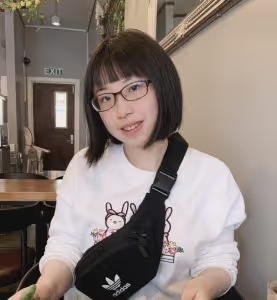
Student volunteer Jasmine shares her volunteering story
Who am I?
My name is Jasmine.
I am 18 years old and am originally from Hong Kong, where I finished middle school.
I moved into New Zealand two years ago, and I am currently a Wellington Girls College student.
I volunteered for Sport Wellington, Marry Potter Hospice and Conservation Volunteers New Zealand for the past few months.I found these volunteer opportunities on Seek Volunteer website.
They display all types of positions and related information on their website.
I contacted the manager to volunteer for these organisations.
Originally it was for the CV and award for the Student Volunteer Army program, but gradually I enjoy doing volunteering jobs.
What did I do for volunteering?
The one I currently volunteer for is Marry Potter Hospice.
I worked there for three hours a week on the weekends.
I enjoy organising the merchandises and maintaining the store cleanliness.
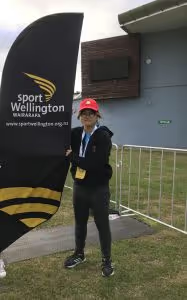
I sometimes in charge of checking out for customers.I also volunteered for Sport Wellington by joining the Round The Bay 2021.
My job was to give necessary help to runners who felt unwell when they passed the finish line.
When someone fell down on the floor or looked unconformable, we approached to check if first aid is needed.
I also in charge of maintaining the finish line order to ensure people follow the right way.
And sometimes give the runners a hand if they need it!
I feel like being able to help someone when they need it and also feel the inspiration for achieving something.
What did I gain from volunteering?
I think one of the best parts of volunteering is making new friends and building connections.
I used to know friends only in school, but ever since I worked as a volunteer, I know people from different backgrounds.
And I even make some wonderful friends of different ages and diverse perspectives.
We are still connecting to each other after the volunteer experience.
The way volunteering brought us together was just fantastic.Another part of what I love about volunteering is skills learning.
When I worked for Marry Potter Hospice in an op shop, I encounter all kinds of customers; I learned to face different customers in a retail setting.
And I get to learn how to do the checkout.
I think it would definitely be helpful for my life and my career in the future.
It gives me a chance to challenge myself in social interaction.Lastly, I think volunteering is a great way to contribute to society.
As I worked for Conservation Volunteers New Zealand, it really makes me think about what I am doing.
I sometimes worked in Mount Victoria and Island Bay.
We are actually doing something to protect the environment; we did the weeding and removed the harmful plants for the trees.
By doing that, I feel like actually helping this place.I will definitely keep doing volunteer jobs in the near future.
As well as retail, customer service, environmental protection, I want to try new things in different fields.
And keep learning from the experience, improving society and myself!
Celina HuangSocial Media SpecialistVolunteering New Zealand
Campaigns
Community
Volunteers
Wellbeing
Youth
VOLUNTEERING LED TO COMMUNITY AND CAREER
Give-Takoha | Grow-Whakatipu | Connect-Tūhono. What Lara gained through volunteering was more than personal value...
Lara began volunteering with Youthline in her first year of studying Psychology, at first to see if it was something that she could pursue as a career.“I kind of thought well if I hate it at least I’ll know now, and if I love it then great, and obviously I loved it because I’m still here”.Through the skills and experience that came from volunteering she was able start working in mental health support.What Lara didn’t anticipate was the friendship and community she would gain through volunteering.“I went in wanting to do it because of my personal values and because of my career goals, but the networks I’ve made, the friends I’ve made, and the new skills I’ve learned is just crazy”.“When you get to the end of training you know that you feel safe to do the work and that other people are really supporting you as well”.Volunteering has given Lara “such an appreciation of how colourful and complex life is [and] how brave people are in sharing their stories”Lara's story is a part of Volunteering New Zealand’s video series, to celebrate Student Volunteer Week (15-21 March 2021). Collective Impact: Give.Grow.Connect” is the theme of #SVW2021.
Student volunteers give a hand to the community, grow as they gain knowledge and create valuable changes, and connect with others.
Students, universities, schools and organisations will be celebrating our student volunteers and connect young people with opportunities to get involved in volunteering. Volunteers grow people, open minds, open hearts and create joy. We hope this video inspires you to connect with a community or cause you care about.For information on how to get involved with #SVW2021 visit www.studentvolunteerweek.nz

Campaigns
Volunteers
Wellbeing
Youth
From student to teacher, coding volunteer leads kiwi kids
Volunteers grow people, open minds, open hearts and create joy. Kusal shares about the fulfilment and gratitude he gets from volunteering for Code Club.
Fulfilment and gratitude
Kusal was first taught how to code by volunteers and found a lifelong passion.
Now he volunteers teaching coding and hopes to inspire kiwi kids in the same way.“I got the opportunity to help volunteer for a code club over at the primary school next door which I jumped at”Kusal volunteers for Code Club, who teach primary aged kids how to code.Though he now works full time in coding Kusal still finds time to volunteer, citing the fulfilment and gratitude he gets from volunteering as more than enough payment.“After a big coding session some of the kids will come up to us and thank us for helping them learn how to code and it’s really cool”.“It’s really cool when you hit that moment when they understand and they know what you’re talking about”.For people who are considering volunteering he encourages everyone to get involved, “if you’ve ever thought about it, or even if you haven’t, just give it a shot”.As for the kids he’s teaching, Kusal hopes that some of them might go on to code as he has done, “that would be amazing if that did happen, I’d really love that”.>>Watch Kusal's volunteering video.Kusal's story is part of Volunteering New Zealand’s video series, to celebrate Student Volunteer Week (15-21 March 2021). Collective Impact: Give.Grow.Connect” is the theme of #SVW2021.
Student volunteers give a hand to the community, grow as they gain knowledge and create valuable changes, and connect with others.
Students, universities, schools and organisations will be celebrating our student volunteers and connect young people with opportunities to get involved in volunteering. Volunteers grow people, open minds, open hearts and create joy. We hope this video inspires you to connect with a community or cause you care about.For information on how to get involved with #SVW2021 visit www.studentvolunteerweek.nz

Advocacy
Leadership
Volunteering New Zealand advocacy update
Volunteering New Zealand works to ensure that volunteering is represented and supported by government departments and the Government.
We continually strive to deliver results in this area.
In this email we are providing an overview on the progress of matters we have previously provided expertise on.We have updates on MOJ Criminal Justice Checks and the proposed legislation for the Police vetting system.
We also have been working with WorkSafe on H&S advice.
There is also an opportunity to provide feeback on the Charities Reporting Standards.Ministry of Justice criminal records checks: The Ministry of Justice currently offers a free service for 3rd party criminal record checks of potential employees/volunteers as a gratis service.
We have previously fed back on the cumbersome paper-based process.
The Ministry of Justice has advised that it is introducing a new online service scheduled to go live in March 2021.
This change should bring the service more in line with the police vetting service checks in terms of useability.
To be able to use the new service organisations (or people) requesting 3rd party checks will need to enrol and subscribe to new terms of use due to be released shortly.> Read more here.
NZ Police vetting services:
Codification of the vetting service into legislation has been in process since the original request for input in 2018.
It has been confirmed that the project to bring the legislation before the house is progressing, with the aim of having a bill before government in the first half of the coming year.
WorkSafe H&S advice:During the previous year we have provided expert advice and collated stakeholder feedback to WorkSafe about its existing resources for volunteers and voluntary associations.
They are drafting updated guidance for PCBUs which is intended to be practical, and containing working examples of various volunteer groups and situations.
It will be released later in the year.Have your say on charities reporting standardsThe New Zealand Accounting Standards Board is reviewinng the Tier 3 & 4 reporting standards for non-profit organisation.
They are looking to see how organisations have been finding the current standards, how easy they are to use, if you have found that any additional custom guidance has made the job of implementing them easier, and so on.
For more information on what the XRB review consists of please follow this link.There are thee ways you can give your feedback.
You can:Complete an online survey
- Complete an online survey
- Complete an online feedback form
- Upload a full submission letter
Michelle KitneyChief ExecutiveVolunteering New Zealand
Community
Leadership
Views
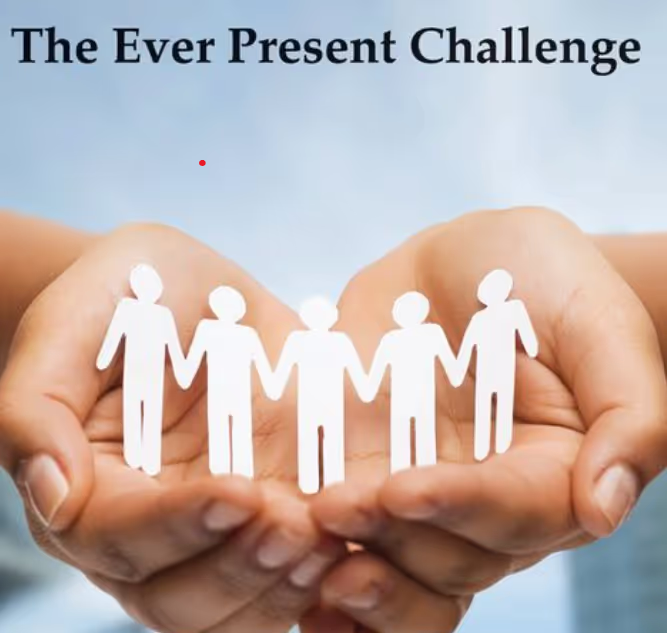
The Ever Present Challenge
In The Ever Present Challenge by Ron and Ngaire Rowe, two of New Zealand’s most well-known volunteers having both received the Queens Service Medal for their charitable community work, put their deep insight of the sector to paper where they explore the fundamental importance of volunteerism within New Zealand and its importance on a global level.The Ever-Present Challenge focusses on the twin topics of strategic leadership and self-betterment, both essential qualities for volunteers and those who operate within the voluntary sector.

This work is a must read for anyone who wants to gain a deeper and more profound understanding of what volunteerism is, why it is of such vital importance, not just to society but to the people who volunteer their time and energy as well, where the importance of volunteerism can go underappreciated in some quarters.The book combines first hand research with real life accounts of what volunteering is like in Aotearoa New Zealand with a strong focus on the work of Volunteering New Zealand and the research done by us on the state of volunteering and its incalculable benefits across the country.One of the standout features of this work is that it is not just an informative guide but also a ‘self-help’ book.
It has helpful information and guidance on how to take the lessons of countless volunteers and managers and put them to best use within your own life or organisation.We can see just how good a read this work is from some of the previous comments and reviews of it; “Inspirational, motivating, uplifting, and timely and relevant” and a general consensus around the outstanding quality of the research and writing to form a fairly unique and highly detailed piece of work on the subject of volunteering.One of the most defining traits of this book though is that it is being sold at cost, with the profits being donated to Volunteering New Zealand and the Centenary Legacy Trust to benefit from any profits on the book.
The book is billed at $30 per copy with $8 of this being donated to VNZ and CLT.You can buy the book directly from Ron and Ngaire or through Volunteering New Zealand.
Please email us for further information: office@volunteeringnz.org.nzCalum SteelePolicy AdvisorVolunteering New Zealand