
News
Stay updated with the latest from Volunteering New Zealand



Research
Volunteers
Wellbeing
Volunteer wellbeing, what works and who benefits?
We know that volunteer wellbeing is a topical issue, and it should also be a central part of a volunteer's interaction within an organisation or volunteering programme. A comprehensive report in which existing literature (158 international studies about the subject of the well-being impacts of volunteering) were reviewed to explore the effects of formal volunteering on subjective well-being for different population groups and different types and levels of volunteering.
The full report is available on our research page.This research explores the relationship between volunteering and wellbeing, and the factors that can influence the wellbeing of volunteers.
The report identifies several key findings:
- Volunteering can have a positive impact on wellbeing: volunteering can have a positive impact on the wellbeing of volunteers, including improved mental health, increased life satisfaction, and increased feelings of happiness and social connectedness.
- The impact of volunteering on wellbeing can vary depending on a range of factors: including the type of volunteering activity, the level of involvement, and the individual's motivation for volunteering.
- Benefits of volunteering are not limited to the individual volunteer: the benefits of volunteering can extend beyond the individual volunteer to the wider community, including increased social cohesion and community connectedness.
- Volunteering can benefit individuals from diverse backgrounds: including those who may be socially isolated or facing disadvantage.
- Organisations can support volunteer wellbeing by providing a supportive and inclusive environment: including opportunities for skill development, recognition and appreciation, and meaningful roles and responsibilities.
Overall, the report highlights the potential for volunteering to have a positive impact on the wellbeing of individuals and communities.
The findings suggest that organisations can support volunteer wellbeing by providing opportunities for diverse and meaningful volunteering roles, creating a supportive and inclusive environment, and recognising and appreciating the contributions of volunteers.
Volunteers
Wellbeing
Five accessible resources to support volunteer wellbeing
Here are five, accessible resources/ links to support volunteer wellbeing.
1.
Te Whare Tapa Whā model of wellbeingThis holistic wellbeing model was developed by leading Māori health advocate Tā Mason Durie in 1984, describing health and wellbeing as a wharenui.
It is a metaphor based on four pillars of a wharenui/ meeting house.
When we look after all four aspects, we look after our hauora/ wellbeing.
Checking in on the four pillars helps us balance our hauora and support others to balance theirs, too.Te Whare Tapa Whā model of wellbeing
2.
Free self-help tools and apps
A list of free tools and apps you can access anytime.
Topics include:
- general wellbeing
- Cognitive Behavioural Therapy (CBT), and
- targeted support for young people.
Free self-help tools and apps
3.
The Five Ways to Wellbeing
This is a set of five simple, evidence-based actions which can improve wellbeing in everyday life.The Five Ways to Wellbeing
4.
Coping with change-related resources:
Change can be exciting, but also challenging, upsetting, and tiring, and may make maintaining your wellbeing more difficult.
It's completely normal to have an emotional reaction to change and to find some days easier or harder than others.It may also help to talk with others and share how you're feeling at this time.
- A one-page resource from the New Zealand Red Cross: Leading through change (PDF file, 1.8MB)
- This A3 poster was written for People Leaders within NZRC: Tips for building resilience through change (PDF file, 100KB)
5 Helplines and local mental health services
In the Mental Health Foundation downloadable PDF guide below you’ll also find contact details for providers with expertise in anxiety, depression, addiction, family harm, parenting and more.
Please reach out to them if you or someone you know needs support.Helplines and local mental health services (PDF, 243KB)

Community
Latest News
Leadership
Research
VNZ Events
What’s all the fuss about Volunteer Management Systems
Organisations with robust electronic systems for managing volunteers kept and engaged volunteers during the Covid years better than those without, according to the State of Volunteering Report 2022.However, how do organisations decide which Volunteer Management System to invest in, and what is their experience of implementing and using one?Our March Ako Kōtui – Networking Series 2023 session covered this topic.
Ako Kōtui are online lunchtime sessions.
Each month guests share their experience of relevant issue AND participants have an opportunity to discuss, share and network.Panel members were: Gail Marshall, co-founder Community Comms Collective; Carey Buck, volunteer coordinator for IHC Friendships Programme Wellington and Hutt Valley; and Jo Guest, contract event volunteer coordinator, Wanaka.
Heidi Quinn, Volunteer Management Lead, Volunteering New Zealand was the facilitator.
Identifying the Need for a VMS
The panellists identified ‘growing pains’ of having too many volunteers and projects to manage without better electronic systems.
If selecting a system, it was important to understand what you needed.
Gail said the Community Comms Collective had the support of a volunteer business analyst to map existing processes with the volunteer managers, identify the data requirements and then the organisation knew what it wanted in a VMS and could confidently go to market.
Jo said the look and function of a VMS was important.Heidi said if you could identify the amount of volunteer manager’s time spent co-ordinating volunteers, you could calculate the savings (in time and money) by implementing a Volunteer Management System.
Benefits to organisation and volunteers
There are many benefits both to the organisation and its volunteers from having a VMS.
Carey uses Better Impact at IHC and said she appreciated having all the information about volunteers at her fingertips.
Volunteers also had easy access to information about their interactions and could self-update.
Many systems had apps or could be accessed from a phone, making communication easy.
The Tipping Point
During the Q&A with the audience, the idea of a ‘tipping point’ for implementing a VMS was raised.
Organisations may be fine with spreadsheets or other more manual processes, but they grow to a point where better digital management is needed.
The decision to invest in a VMS can be to do with measuring volunteers’ impact and the organisation’s strategy and purpose.You can watch the panel discussion here.Here are some useful links:Advice about choosing a VMSCapterra: reviews of Volunteer Management SoftwareSoftware Advice: Volunteer Management Software

Inclusion
Leadership
Episodic volunteering - lessons we can draw from research
Episodic volunteering: review of evidenced best practice
Episodic volunteers prefer short-term, time-limited or irregular volunteering opportunities.
Therefore, episodic volunteering may be viewed as an alternative to other, more traditional forms of volunteering.Episodic volunteers tend to be time poor, and typically do not have the resources available to commit to longer-term or more regular volunteer roles.Flexibility is extremely important for episodic volunteers, both in terms of the roles performed (which should match the individual’s interests and skills) and the amount of time committed.
What does this mean for volunteer managers?
Organisational analyses have highlighted both costs and benefits associated with utilising episodic volunteers for events and in emergency situations (for example, Handy & Brudney, 2007; Volunteer Canada, 2006).
Episodic volunteers may generate fewer benefits than regular volunteers because of the training and support required, and volunteers’ wavering commitment to the organisation.However, for many organisations, episodic volunteers are essential in terms of maintaining volunteer supply.
Many benefits of utilising episodic volunteers have been identified, including:
- Building social capital within the organisation
- Increasing perceived links between the organisation and the community
- Increasing organisational capacity
- Maintenance of regular (or core) services in times of emergency or during a special event
- Utilisation of volunteers’ specialised skills and knowledge that would otherwise not be available within the organisation
- Freeing up time for essential or core staff to undertake higher-level tasks
- Building a long-term volunteer base for future endeavours (Handy & Brudney, 2007; Volunteer Canada, 2006).
From a volunteer management perspective, this involves tailoring roles according to individual preferences and providing a range of different options to choose from.
Designing episodic volunteering roles
Episodic volunteering roles should be well defined, designed specifically for short-term work and have discrete completion points.Because of the importance of flexibility, volunteering opportunities that offer options such as job sharing or flexible hours are highly attractive to episodic volunteers.Volunteer roles should be perceived as making a meaningful (rather than menial) contribution to the broader mission of the organisation.
The work should be challenging and engage the volunteer so they choose to ‘bounce back’ i.e. return to volunteer again in future.Being personally asked to take part in an episodic volunteering opportunity is an important determinant of individuals taking up that opportunity.Reasons for engaging in episodic volunteering can be both altruistic (for example, a desire to ‘make a difference’) and egoistic (for example, socialising).
Episodic volunteers who are involved for altruistic reasons are more likely to ‘bounce back’ than those involved for egoistic reasons.
Converting episodic volunteers to long term volunteers?
Management practices associated with greater retention of episodic volunteers include recognition of volunteers, offering training and professional development and screening procedures to assess suitability for the role.Retention of episodic volunteers tends to be lower for charities without the resources to support volunteers adequately.
Furthermore, volunteer satisfaction is related to both supervisor availability and the quality of service provided by management (Cnaan et al., 2017).
These factors were linked to intention to volunteer again, indicating that quality of supervision and communication by management are important predictors of episodic volunteers returning (or ‘bouncing back’).
Recommendations for episodic volunteers
Based on the research and evaluations reviewed, evidence-based recommendations for episodic volunteer programmes include:1.
Ensuring that the types of roles offered to episodic volunteers are:* Identified through consultation with key stakeholders* Engaging and meaningful* Flexible and offering a range options to potential volunteers* Clearly defined, with written position descriptions2.
Gaining a sound understanding of the motivations and preferences of episodic volunteers for the specific organisation and type of volunteering opportunity being offered3.
Ensuring the development of customised marketing communications according to motivations of volunteers and the particular volunteering opportunity available.
This is likely to vary for specific types of volunteers, such as older, one-off events and international humanitarian episodic volunteers4.
Preparing governance structures for programmes utilising episodic volunteers that include the following key elements:+ Carefully matching the specific skills, knowledge and motivations of individual volunteers with suitable volunteering roles+ Appropriate levels of training and orientation for the roles being performed, while keeping resource expenditure to a minimum+ Appropriate levels of supervision and monitoring, including providing a contact person to whom volunteers can go for guidance, and ensuring supervisors are available and communicate effectively with volunteers+ Recognising and rewarding volunteers appropriately according to the type of role they are performing+ Evaluating episodic volunteering programmes in terms of whether goals are met, but also in terms of the satisfaction of volunteers with their experience5.
Utilising a range of communication channels to inform people about opportunities for episodic volunteering, particularly using the internet and social media6.
Where possible, extending a personal invitation to past volunteers to increase bounce back for future volunteering opportunities.These insights were drawn from a recent research report, Episodic Volunteering - Rapid literature review published by the Family & Community Services, NSW Government, 2022.
It was a review of relevant literature and evidence-based recommendations regarding best practice in the governance of flexible, time-limited episodic volunteer programmes.

Advocacy
Conservation
Identifying, supporting and retaining environmental volunteers and leaders
By Michelle Kitney, Chief Executive of Volunteering New ZealandWhile I was at the Volunteering Australia Conference 2023 on 13-14 February, Post-Tropical Cyclone Gabrielle was wreaking havoc across the motu.One session at the conference stood out as particularly relevant.
It was on environmental volunteerism and it explored the critical role that volunteers play in conservation and addressing environmental challenges.The presentation covered research and practical strategies for volunteer leaders and co-ordinators active in the environmental sector.
Presenters included Fiona Tucker, Robyn Gulliver a researcher and Katie Ronald from Bush Heritage Australia.Activism organisations, and their volunteers typically seeks to change something, eg behaviours or laws, and often achieve this through various types of advocacy.
Despite their importance, little is known about the factors that motivate individuals to engage in different environmental volunteer activities.
Research on working with environmental volunteers and leaders
Robyn Gulliver presented research she had collaborated on in regards to activism organisations with a focus on environmentalism, and surfaced key findings from each provided an overview of three relevant studies that fed into her research.
Her presentation offered findings and takeaways for working with environmental volunteers and environmental volunteers leaders.The research found that volunteers play critical roles in leading the activities of environmental organisations seeking to address the environmental crisis.Drawing on an extended Theory of Planned Behaviour model, this study surveyed 259 experienced environmental volunteers who had participated in a range of environmental volunteer “leadership” and “participation” (i.e., non-leadership) behaviours to identify factors associated with these behaviours.Findings indicate that higher self-efficacy beliefs about specific leadership tasks, and higher past participation in participation behaviours, were significant predictors of engaging in more leadership behaviors.
Higher self-efficacy and stronger identification as an environmental volunteer also predicted increased participation behaviours, as well as a younger age.Qualitative analysis of open-ended responses highlighted the importance of organisational factors such as training opportunities and receiving support and appreciation from the group in building leaders’ self-efficacy.Finding Study 1 Reviewed how many environmental activist groups were operating across Australia.Her research found that:
- There were activist environmental groups all over the country, with a total of 3000 groups across Australia
- Many of these organisations operated without formal structure, with many groups only found on social media
- Some remained hidden, and most were not engaging in illegal actions.
- Most, if not almost all, are led by volunteers.
Finding Study 2 - Survey of environmental volunteersA survey of 195+ environment volunteers focusssed on finding out what predicts environmental volunteer behaviours.
Findings that surfaced include that:
- For participation – identification as environmental volunteers
- For leadership, belief they are capable of leadership behaviours (leadership self-efficacy)
It also explored what attracts new volunteers and sustained volunteer leaders, including:
- Social benefits – being listened to, supportive team, feeling valued and sense of belonging
- Specific traits and behaviours of volunteer leaders were important to the volunteers.
In regards to what resources volunteer leaders needed the most, it found that these factors made a difference:
- A positive social context
- Volunteers with initiative and autonomy
- More time (if they personally had time to give).
Environmental activism can often be hard to show achievements, and often the results are not as expected.
The research explored how environmental activist leaders overcome failure.
These were the tactics that worked:
- Re-evaluate success in a different category
- Emphasise individual benefits of activities to participants
- Changing tactics.
Key takeaways to Identifying, supporting and retaining environmental volunteers and leaders:
- Convey a shared identity
- Use inclusive language
- Include imagery conveying diversity
- Build in welcoming procedures/individual relationship building
- Define/support different roles suitable for different interests
- Communicate a variety of tactics
- Prioritise welcoming teams and opportunities for success.

Advocacy
Latest News
Leadership
News
Recognition
Five wins for volunteering in 2022
Have you taken stock of your achievements for the past year?Alongside the successes volunteering brings to people and organisations, Volunteering New Zealand advocates for nationwide goals to improve volunteering for all.
Before 2023 accelerates much faster, we’d like to share five wins for volunteering for 2022.1.
One in two people volunteer, and we’re doing more hours than before.
In 2021, 50.7 percent of people had volunteered in the previous month (a 0.9% increase from 2016).
This includes people who volunteer for an organization, and those who volunteer directly for another person.
Total volunteering equates to 9 million hours a week!
This data comes from Statistics New Zealand’s General Social Survey, issued in September 2022, from population representative diary entries.2.
Volunteers rate the state of volunteering in 2022 as almost the same as pre-Covid (6.7 out of 10), and over 80% intend to continue volunteering long-term.
Their primary motivation is to contribute to their communities.
Volunteering New Zealand’s State of Volunteering report for 2022 shows the state of volunteering is generally in good health!3.
A cross-government group on supporting and strengthening volunteering has been formed, as an outcome of the DIA’s Strengthening our Approach to Volunteering It recognizes the need for a more strategic approach to volunteering across 30 government agencies, and the role of government in supporting volunteering role and infrastructure.
The group, which includes Volunteering New Zealand Chief Executive Michelle Kitney, has agreed to focus on reducing the compliance burden for volunteer organisations and investment in volunteering infrastructure and diversity.4.
Volunteers and volunteer managers will have better access to training, because of the Vocational Education Reforms.
Volunteers can now access funded vocational training – a change Volunteering New Zealand advocated for in 2019.
The formation of six new Workforce Development Councils / Ohu Mahi provide an opportunity for new qualifications relevant to managing volunteers.
Volunteering New Zealand is discussing what these could look like with two of the Councils.5.
Volunteers’ contribution to the wellbeing of New Zealand is now being measured and valued.
The Government’s Living Standard Framework now includes indicators of volunteering – including participation in volunteering and informal volunteering by young people.Woop, woop!
Looking forward to what we can achieve together with the sector in 2023!

Advocacy
Latest News
Research
VNZ Events
VNZ in the News
Community Sector Engagement Group meeting
The Community Sector Engagement Group met with the Hon Priyanca Radhakrishnan, Minister for the Community and Voluntary Sector, on 10 November 2022.Volunteering New Zealand is a representative on this sector engagement group, which meets regularly with our Minister for the Community and Voluntary Sector.
- The Minister acknowledged that the sector had another hard year as we continue to respond to the impacts of COVID-19.
- She thanked participants for their hard and on-going work.
- The Minster noted the Social Cohesion work being led out by MSD and the sector’s connection to this work and framework and asked the group to put forward what would be useful for the community sector and how the Government can support their work in social cohesion.
- The Minister is keen to receive feedback from the community organisations on the Charities Amendment Bill and the submissions have been extended to 9 Dec 2022.
- A cross government group on volunteering is now meeting regularly, as an outcome of the Strengthening our Approach to Volunteering Report.
- Michelle Kitney, Chief Executive of Volunteering New Zealand has been invited to join this group, and has attended her first meeting.
- The group has collectively agreed to focus on two top priorities: i) Reducing the compliance burden for volunteer organisations ii) investment in volunteering infrastructure and diversity.
- All participants shared resources in terms of how they incorporate Kaupapa Māori Frameworks into their organisations.
- The Group agreed that, while COVID-19 had been the catalyst for the establishment of the Minister’s Community Sector Engagement Group, there was value in continuing to meet next year.
The next meeting of the group will be in early 2023.
Please email Michelle Kitney - michelle@volunteeringnz.org.nz with any thoughts or ideas to contribute to this meeting.

Community
Diversity
Inclusion
Social justice
International Volunteer Day 2022 – Resources

International Volunteer Day (IVD), on 5 December 2022, has the theme of solidarity through volunteering.
For the future of our planet, we must act together and we must act now.
This is not an era to stand alone but together, as one, in solidarity with each other.
On 5 December, let's join with all volunteers across the globe to recognise the power of volunteering.
Volunteering is where compassion meets solidarity.
Both share the same core values – supporting each other from a position of trust, humility, respect and equality.In the lead up to #IVDAY2022, join us to celebrate the spirit of volunteerism.
We are proud of all volunteers who are role models in their communities and whose actions inspire hope.Read our media release: Volunteers ensure communities supported.#IVD2022 – Start promoting todayDownload these resources
- Copy for social media/ website: 50/100/200 words
- Facebook header V01
- Facebook header V02
- Facebook header V03
- Web header V01
- Web header V02
- Social media post V01
- Social media post V02
- Social media post V03
- Email signature V01
- Email signature V02






Advocacy
Inclusion
Latest News
Mahi Aroha
Research
State of Volunteering update
Volunteering New Zealand’s deep dive into the state of volunteering is nearing completion. In this update we tell you what we set out to do, the research we undertook and the key themes of our report. We’re aiming to have the substantive report out before the end of 2022. Sub-reports will follow.
Pre-design consultation
We kicked off our SOV2022 with a pre-design consultation with stakeholders.
This informed how we designed our research.
The main needs were: capturing the view of Māori, Pacific and other ethnic communities; capturing regional data where possible; gauging volunteer wellbeing and understanding motivations.
Methodology
We applied a mixed methods research methodology to studying the state of volunteering in Aotearoa in 2022. This included:
- Focus groups with Māori volunteers
- Interviews with young people and volunteers with disabilities
- Utilising current research on Pacific peoples
- Surveys with volunteers
- Surveys with volunteer-involving organisations
- Lessons from Te Ao Māori and Kaupapa Māori
We received rich, diverse and inspiring views from across New Zealand.
We hope to be able to provide some regional insights.
Key themes
The research report will synthesize the information around a series of themes:
- Barriers and motivations for volunteering
- Volunteering and Whakawhanaungatanga: relationships and connections
- The public, organisational and personal benefits of volunteering
- Recognising and valuing volunteers and volunteering
- The impact of Covid-19 on volunteers and volunteering
- Diversity and inclusion in volunteering theory and practice (including volunteers with disabilities, Pasifika, youth, Māori)
We have a draft supplementary report on Māori and mahi aroha, and aim to have additional supplementary reports on Covid learnings, and regional analysis ready for release in 2023.We look forward to sharing the results with you in webinars and other fora.
If you have any question or comments, please email: office@volunteeringnz.org.nz

Campaigns
Leadership
International Volunteer Managers day 2022 resources

International Volunteer Managers Day (IVMDay) is held annually on 5 November.
The theme this year 200 is Many Backgrounds – One Profession – Stronger Together.Volunteer managers responded to the challenges of the last year with strategic leadership and created partnerships and collaborations to continue to thrive.For some, their own health and wellbeing suffered as they kept their teams operating to support their communities.Volunteer Managers are the key to successful volunteer involvement.To mark IVMDay, we’ve selected our top six VNZ resources, tools and research to support managers of volunteers!
Please share with any managers of volunteers that you know.1. Lead MeMaximise your volunteering leadership potential.
Take this quick and easy assessment.
At the end, we’ll email you a status report, an action plan for change, and links to useful resources.2. On-demand learningWatch webinars on demand, including newly added topics for 2022: Pasifika unpaid work, youth participation in governance and skills from volunteering for job hiring.
Our guest presenters are leading national and international speakers, exploring topics on volunteering to help you better lead, manage and develop your volunteer workforce.3.
Regional training and eventsWe collate upcoming training and events from across the motu.
Many are online and free, giving you access to learning wherever you are.4.
Volunteers and the lawThere are a range of laws that have implications on how organisations interact, treat and manage volunteers.
We have collated information about employment, health and safety, volunteer rights and volunteer expenses.5. Volunteering resourcesWe collate and continually update resources to support managers of volunteers and the governance of volunteer-involving organisations.
These resources include practical advice and strategies from leading national and international organisations and contributors.
See: https://www.volunteeringnz.org.nz/available-resources/6. InvolveMeInvolveMe is an online self-assessment tool that helps you make a great volunteer programme.
Survey your organisation to get the best out of your volunteer programme!
InvolveMe provides you with a broad set of questions that are then summarised into a smart and easy to understand report.
This report makes it a breeze to self-identify where you or your organisation can improve its effectiveness.Any questions about these resources?Please contact us at office@volunteeringnz.org.nz.About the 2022 themeThe theme for 2022 is: “Many Backgrounds – One Profession – Stronger Together”. This theme conveys a strength the volunteer leadership sector possesses that we don’t draw on enough… the huge and diverse range of backgrounds that volunteering leaders come from.
On one hand – we come from a wide range of professional backgrounds.
We are also made up of people from all walks of life and different cultural backgrounds.
We believe that this diversity of backgrounds should allow us to think differently, we can find solutions together when we come at issues from different perspectives.
As we all have different skill sets we should be able to collectively collaborate and use these more productively.
#IVMDAY22 – Start promoting today.Download:
- Facebook header
- Twitter header
- Social media theme post
- Engagement post V01 – "Before I was a Volunteer Manager, I thought I would be..."
- Engagement post V02 – "Before I was a Volunteer Manager, I thought I would be..."
- Engagement poster V03 – "Before I was a Volunteer Manager, I thought I would be..."





Advocacy
Latest News
Research
VNZ Events
VNZ in the News
Community Sector Engagement Group meeting
The Community Sector Engagement Group met with the Hon Priyanca Radhakrishnan, Minister for the Community and Voluntary Sector, on 11 August 2022.Volunteering New Zealand is a representative on this sector engagement group, which meets regularly with our Minister for the Community and Voluntary Sector.The Minister acknowledged the opportunity to regularly engage with the CSEG as these meetings provide a platform to check in and discuss the on-going impacts of COVID 19 and the support provided by the sector to communities.The Minister spoke to the importance and impact of the Community Organisations Grants Scheme (COGS) and commented on the issue that it and has been operating with an outdated funding formula for several years.
This is resulting in inequitable distribution of funding to communities.
Further to this, the appropriation has not increased for a number of years.As a member of the Lottery Grants Board, the Minister raised the Board’s programme to evolve the Lottery funding model Kia Tipu, He Tipua Work Programme to make it easier, equitable and fairer for communities, hapū and iwi to access funding.
High-level options for evolving the Lottery Funding Model will be presented to the Lottery Grants Board in November.The report on Strengthening our Approach to Volunteering was released by the Minister in June 2022 as part of the National Volunteer Week.
A key recommendation of the report was to establish a Cross-agency Steering Group to develop a strategic approach to volunteering across government.
The group has been established and met for the first time on 28 July 2022.The review of the best practice guidelines for volunteers is another key recommendation of the report and is being progressed by Volunteering New Zealand, supported by the Department.The Charities Act changes include introducing a more accessible appeals body for charities to challenge decisions, and new powers to reduce reporting requirements for small charities.
The Minister has introduced a bill to parliament and is aiming to pass it next year.
There will be an opportunity to make submissions to the select committee.
The minister encourages groups to get involved with the process to make sure we get the accurate legislative changes.The Group discussed some of the key issues currently facing the community and voluntary sector including:- Ongoing impacts of COVID-19 for the sector- significant concern across the community sector around the well-being of workers.- that people/volunteers are experiencing high levels of exhaustion- cost of living as a significant issue both in terms of demand for more community support and the costs for non-profits to deliver services- administration burden of community groups reporting to different government agencies and simplifying accountability requirements.- desire to support Government agencies in using a community led development approach- how Government agencies can work effectively with Pasifica and Māori- impact of the anti-money laundering legislation on community organisations in terms of banking and complianceThe next meeting of the group will be in November.
Please email Michelle Kitney - michelle@volunteeringnz.org.nz with any thoughts or ideas to contribute to this meeting.

Diversity
International
Leadership
Harnessing the energy of volunteering
Now is a great time to harness the energy of volunteering, adapting volunteering to a post-Covid world and seeking out diverse volunteer audiences, according to two articles from Engage.In Is there a New Energy in Volunteering?, Rob Jackson and Erin Spink say they are seeing many new initiatives to develop strategies, visions and plans for volunteering.“As the world and people’s lives change, so too must volunteering shift to fit within new ways of living, emerging priorities and values and ways of connecting.
It is timely for new strategies, visions and action plans to be developed to explore how volunteering needs to adapt in a post-Covid world.”They say that volunteering is at an all-time high in public and organisational consciousness and that volunteering gives us hope that we can change the world for the better.The authors cite England’s “Vision for Volunteering” as a great approach. “It doesn’t faff about with naval-gazing definitions of volunteering… powerfully, it puts volunteers at the heart of volunteering.”However, volunteerism exists within social institutions and power structures, so in order to make volunteering more inclusive, key changes need to be made, the authors say.In a second article, Overcoming Unseen Barriers: How to Authentically Engage Diverse Volunteer Audiences, author Sam Fankuchen suggests a way volunteer managers can champion inclusion.“The beauty of volunteering, to me, has always been that it can present an opportunity for each of us – over a session or over a career – to prioritize someone else’s needs and see the world through their eyes for a moment.
And these moments cannot happen without diversity, equity, inclusion and belonging.”He defines these terms as:
- Diversity – representation of a range of stakeholders who identify differently in one or more facets of our being
- Equity – similar access to opportunity, even when our diversity may obscure that opportunities exist and be reasonable, possible and fair to pursue
- Inclusion – welcoming design of a programme or opportunity for anyone capable of participating
- Belonging – internalising the feeling of sincere engagement in purpose and action.
Engaging with a broader audience could make the difference between how a programme operates now, and the potential for the best version of a programme.Fankuchen suggests ways to engage with a diverse audience, including asking detailed questions about how an audience member defines themselves, and using technology to enhance the users’ experience.“When you make small efforts to be more inclusive, bigger patterns emerge.
Suddenly you make small realizations, implement incremental changes, and witness broader reach and engagement.”These articles can be read in the Engage Journal, an online journal for volunteer engagement leaders.
Volunteering New Zealand members can receive access to Engage free of charge.
Email: office@volunteeringnz.org.nz if you are interested.

Research
Sustainable Development Goals
Volunteers
Wellbeing
Volunteering and wellbeing
The introduction of Treasury's Living Standards Framework into the 2019 Budget is being greeted enthusiastically by a number of organisations including Volunteering New Zealand.
The Wellbeing Budget, as it is known, will take a more holistic approach to valuing what is important to New Zealanders, including for the first time, social and environmental indicators as well as measures of economic health.
Work in the area of wellbeing has become established over the last decade both internationally and in New Zealand and many of the objections and obstacles to measuring "intangibles" such as wellbeing have been overcome.The Living Standards Framework will measure the progress of four capitals:
- Produced capital - infrastructure assets
- Human capital - skills, knowledge, and human health
- Social capital - norms and values like trust and cultural identity
- Natural capital - the environment as a resource
So how can volunteering contribute to wellbeing?
Volunteering can build value in our capital stocks in some obvious ways.
For example, sports volunteering enhances the health of those who take part, while environmental volunteering helps to protect natural resources.
But just about any kind of volunteering can contribute to social and human capital in the sense that volunteering is both a social interaction and an opportunity for learning and development.
As opposed to traditional measures of capital, social and human capital are not depleted with use.
Time spent sharing trust and knowledge are investments that can increase the total value of New Zealand's productive resources.
Volunteering and wellbeing: the evidence
In order to study the effects of volunteering on subjective wellbeing, social scientists are careful to control for what they call "confounding" or "lurking" variables - unobserved variables that seem to suggest relationships between other variables that do not exist.
For example, an increase in sales of ice cream and an increase in the murder rate over the summer months does not suggest that one causes the other.
Rather, another variable, the weather, is likely to explain why ice cream sales go up.

In our research section, we have provided a link to a 2012 study by Martin Binder and Andreas Freytag which provides a robust and causal demonstration of the impact of regular volunteering on subjective wellbeing using a large-scale data set, the British Household Panel Survey.
Perhaps the main finding is that "regular volunteering significantly increases well-being" and that the "causal effect of volunteering ... increases over time for individuals who continue their volunteering efforts." Genuine volunteering - that is, volunteering that is conducted by choice not obligation - is unlikely to have negative effects.
However, examples of people who benefit the most from volunteering are retired persons, the lonely or the unemployed.Binder and Freytag test the robustness of their results by controlling for numerous "confounders" such as personality traits, social networks and trust as well as comparing across demographic slices such as gender, age, education, frequency of social contact and so on.In addition to their main findings on wellbeing, the authors also summarise the benefits of volunteering as studied elsewhere.
These studies find that volunteers report better outcomes across a number of terms related to or synonymous with wellbeing including health, social life, socio-economic prospects, happiness, positive affect for the elderly, and life satisfaction.

International
Latest News
Leadership
Revolutionary Leadership for 21st-Century Volunteering
Your views on volunteer management will get a seismic shake-up from this article by author and volunteer management expert Martin J.
Cowling published in the ENGAGE journal.Here is a summary.
Volunteering trends
Volunteering has changed and Covid-19 simply exposed that change.
Our older volunteers are disengaging from volunteering and most organisations are completely failing to attract the newer generation.
Volunteering has to compete for the most valuable resource humans have: time.
In many countries, we have seen a massive ‘shock’ in volunteering numbers.
Participation rates have plunged, the hours contributed declined and organisations are reporting that ‘their’ volunteers are simply not returning.BUT people are still committed to causes they are passionate about and willing to give time for them.
Somewhere between these people wanting to make a difference and our current volunteering organisational models lies a huge chasm.
Cowling argues that leaders of volunteers need to bridge that gap with a revolution.
Only they can mobilise the community to solve the issues of the community.
New standards needed
Cowling gives seven standards that revolutionary leaders need to create a vision of volunteering in the 21st century.
- Sell the impact of volunteering.Ask your volunteers, how has volunteering for us impacted you?
- Then use that information to sell volunteering to your community.
- Create a strategic organisational view of volunteering.Volunteering needs to be front and centre of an organisation’s community impact and fundraising strategy
- Redefine volunteer characteristics.
- For example, volunteers want have a sense of wonder and excitement, to do something meaningful, use their skills, and connect with others.
- Maximise flexibilityTraining and volunteering needs to when people have spare time e.g. weekends, and in the way they want e.g. online.
- Maximise visibilityEngage members of your community using the internet and social media.
- Embrace diversityDo your materials and practices address your diverse audiences?
- Maximise volunteer satisfactionVolunteers are brand ambassadors for volunteering.
- If volunteering is negatively impacting your volunteers, make changes.
- Check in regularly with volunteers to find out how satisfying volunteering is for them.
Which of these practices will you change up?The full article can be read in the Engage Journal, an online journal for volunteer engagement leaders.
Volunteering New Zealand members can receive access to Engage free of charge.
Email: office@volunteeringnz.org.nz
Advocacy
Recognition
Volunteers
Wellbeing
Volunteering added to Living Standards Framework
Living Standards Dashboard now includes volunteering indicators Treasury has a refreshed Living Standards Framework (LSF) Dashboard, which now includes indicators and measures relating to volunteering.In April 2022 Caralee McLiesh, Secretary to the Treasury launched the paper Trends in Wellbeing in Aotearoa New Zealand, 2000-2020 (Wellbeing Trends Report) and a refreshed LSF Dashboard.Volunteering New Zealand is excited to see it includes new indicators relating to volunteering are now included in the LSF Dashboard.DOMAINIndicatorMeasuresWork, care and volunteering domainVolunteeringPercentage of adults who reported having done voluntary work in the previous four weeks.
Source: New Zealand General Social Survey (Stats NZInvolvement in the community Definition: Proportion of young people who report helping others in the neighbourhood or community (eg, helping out on the marae or at church or belonging to a volunteer organisation).
Source: WhatAboutMe surveyCivil SocietyNon-profit operating surplus Definition: Operating surplus for the non-profit sector as a proportion of income.
Source: Source: Non-profit institutions satellite account (Stats NZ)One of New Zealand’s areas of strength is in the work, care and volunteering domain.
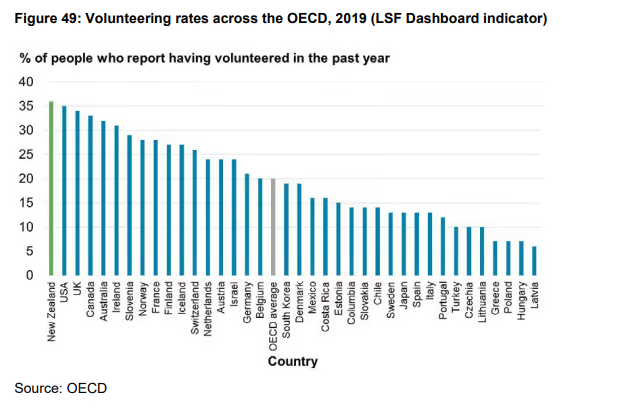
We have high employment, high job satisfaction, low unemployment, and the highest rate of volunteering in the OECD.
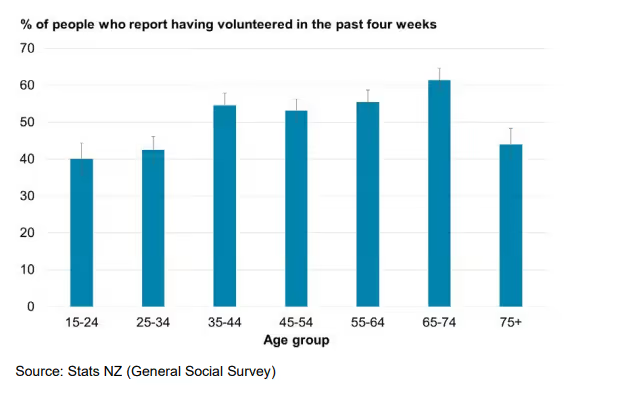
Other key information highlighted in these reports include that volunteering appears more common among people aged 35-74 and includes both direct volunteering and volunteering for an organisation.
The Wellbeing Trends Report investigates how wellbeing in New Zealand compares to other countries, how wellbeing has changed over time, and how wellbeing is distributed across various groups of the population.The updated LSF Dashboard includes new indicators on the health of institutions, and measures that reflect child wellbeing-such as child poverty in the income domain, childhood injuries in the safety domain, and caring and support for young people in the redefined family and friends domain.The Wellbeing Trends Report and updated LSF Dashboard have informed the publication Te Tai Waiora: Wellbeing in Aotearoa New Zealand 2022, a new requirement under the Public Finance Act.
The Treasury has drawn on the Living Standards Framework and He Ara Waiora to provide insight into a range of aspects of life that New Zealanders value.
Te Tai Waiora uses these frameworks to provide a high-level overview of wellbeing in Aotearoa New Zealand, how it has changed over decades, and how well we are positioned to sustain our wellbeing over time.

Advocacy
Volunteers
Youth
Youth Volunteers shine this National Volunteer Week
It’s time to highlight one of our greatest resources, youth volunteers, this National Volunteer Week Te Wiki Tūao ā-Motu 19-25 June. “You can cite quite a few benefits, from skill building to CV improvements, but in all honesty, I don’t volunteer because of anything as tangible as that.
I volunteer because it helps me to hope,” says Dante Dawes, a Youth Working Group member.Formed in 2021 to determine how youth representation at a governance level within Volunteering New Zealand should take place, VNZ’s Youth Working Group (YWG) brings together young minds from all around the country who understand the importance of incorporating and supporting youth voices in organisations, especially at a decision-making level.How the YWG is making a differenceOur team of eight recognises there are a lot of different ways to support the youth voice in this space.
We have identified a number of projects that aim to make a difference.
For rangatahi keen to volunteer, it can be hard to know where to begin - we’re creating a monthly newsletter which aims to provide a convenient way to start people on their journey while recognising that volunteering can feel overwhelming to youth who feel they lack the skills.
Tying into this work, we want to focus on projects which upskill our youth.
We hope to do this by organising, advertising and hosting workshops aimed at teaching youth how to grow their skill-set through volunteering, and get the most out of their efforts.
We want to build a community as volunteering is so much more valuable when there are others alongside you.
Another project involves us reaching out to other youth councils to build a strong network of like-minded people and form a cohesive network of passionate volunteers.Importance of youth engagement and involvement “While youth are juggling everyday life and trying to find what they are passionate about, organisations and society should remember that when they have a young person on board, their voices should be heard and valued as they are a significant part of society,” Swetlana Khoo a YWG member says.
And why does the youth voice matter?
Because our world is going through a massive transition phase.
The knowledge and experience of long term volunteers will always be of the utmost importance.
But as we shift to a new age of social media, digital content and casual volunteering, organisations need a wider array of skills, some of which can only be offered by youth, as the ones born and raised in that environment. Our call to actionAotearoa New Zealand’s youth bring new ideas and diverse perspectives.
We’re incredibly lucky to have so many passionate student volunteers who spend their precious free time helping our communities thrive, now let’s make sure they’re given their time to shine.This week we call on leaders who depend on young volunteers to step up and:
- Build spaces for youth representation at a decision-making level.
- Support youth volunteers balancing work, study and life commitments.
We applaud the many organisations already adding a seat to their board table for youth members.
We encourage these organisations to widely promote their youth board positions.